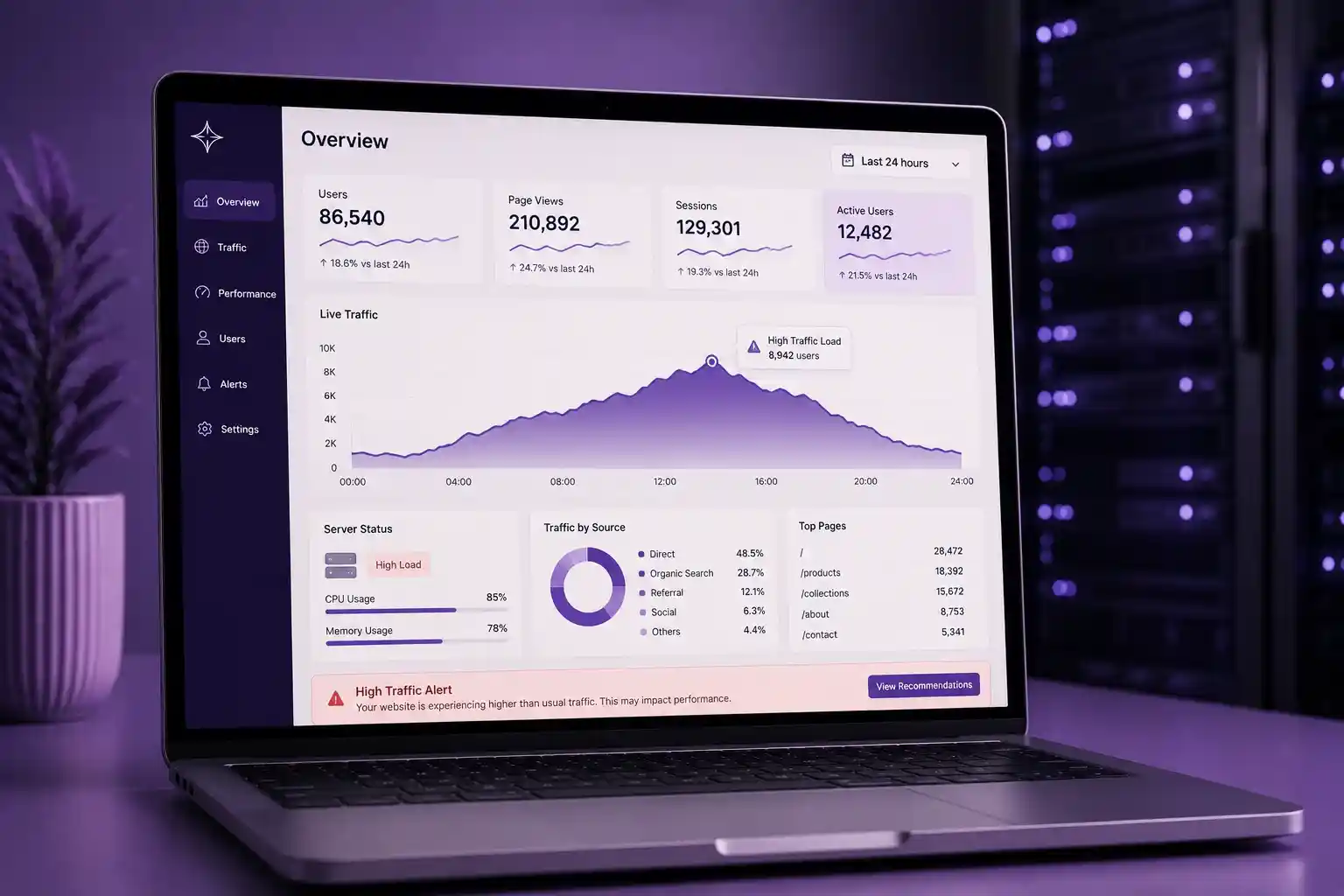
A sudden surge in website traffic should be a win. More visitors mean more visibility, leads, and sales—at least in theory. In reality, many business websites slow down, break, or completely go offline the moment traffic increases. This isn’t bad luck. It’s a structural issue rooted in how the website was built, hosted, and maintained.
If your website can’t handle growth, it’s not a marketing problem—it’s a development one.
This article explains why most business websites collapse during traffic spikes, what’s really happening behind the scenes, and how to fix it before lost revenue becomes a recurring pattern.
Traffic Spikes Don’t Break Websites — Weak Foundations Do
A properly built website is designed to scale. When traffic increases, it should adapt smoothly. When a site crashes, it usually means one or more of these foundational elements were ignored during development.
Discover Our Expertise
Explore our company profile to learn more about our Digital Transformation Services, and how we can help your business thrive in the digital world.
Many businesses focus heavily on design and content, but overlook architecture, server configuration, and performance optimization—the exact elements that matter most under pressure.
This is where professional website development services make the difference between growth and downtime.
1. Shared Hosting Can’t Handle Real Demand
One of the most common reasons websites fail under traffic is shared hosting.
On shared servers:
- Your website competes with dozens (or hundreds) of other sites
- CPU, memory, and bandwidth are limited
- Traffic spikes from any site can affect yours
When your campaign, SEO ranking, or ad performs well, the server simply can’t allocate enough resources quickly.
Businesses that plan for growth typically migrate to scalable hosting setups during development—something often overlooked without expert guidance from a professional website development company.
2. Poor Backend Architecture Bottlenecks Performance
Even with good hosting, a weak backend will collapse under pressure.
Common backend issues include:
- Unoptimized database queries
- No caching layers
- Heavy plugins or bloated CMS configurations
- Synchronous processes running during page loads
Each visitor triggers multiple server requests. Multiply that by hundreds or thousands of users, and performance degrades rapidly.
Modern development focuses on efficient backend workflows, caching strategies, and scalable logic—principles that are baked into high-performance builds created by experienced development teams.
3. No Caching Strategy = Repeated Server Stress
Caching is what allows websites to serve content quickly without rebuilding every page from scratch.
Without caching:
- Every visitor generates fresh server requests
- Databases are hit repeatedly
- Load times increase exponentially during traffic spikes
Smart caching (browser caching, server-side caching, CDN integration) is a core part of scalable website builds and ongoing website maintenance.
If caching wasn’t implemented during development—or is misconfigured—your site is guaranteed to struggle when attention increases.
4. Frontend Assets Are Too Heavy
Large images, uncompressed videos, unnecessary scripts, and outdated frameworks significantly increase page load times.
When traffic spikes:
- Heavy assets consume bandwidth
- Browsers struggle to load pages simultaneously
- Mobile users experience timeouts or broken layouts
High-performance websites are built with asset optimization, lazy loading, and responsive delivery from the start. This is why traffic-ready websites aren’t just designed—they’re engineered.
5. No Content Delivery Network (CDN)
A CDN distributes your website’s content across global servers so users are served from the nearest location.
Without a CDN:
- All visitors hit one server
- International traffic increases latency
- Peak loads overwhelm the origin server
For businesses running campaigns, ranking on search engines, or targeting multiple regions, CDN integration is no longer optional—it’s foundational and often managed through ongoing website maintenance services.
6. Website Maintenance Is Ignored Until Something Breaks
Many business owners treat maintenance as optional. In reality, websites degrade over time.
Without continuous maintenance:
- Plugins become outdated
- Security patches are missed
- Performance issues accumulate
- Compatibility breaks after updates
Traffic spikes expose these hidden weaknesses instantly.
This is why scalable businesses invest in proactive website maintenance—not emergency fixes after downtime costs sales.
7. Marketing Outpaces Website Readiness
Ironically, successful marketing often reveals weak websites.
SEO campaigns, paid ads, influencer mentions, or viral content can all drive sudden traffic. If the website wasn’t built to support growth, marketing success becomes a liability.
This is why high-performing businesses align SEO, PPC, and website development from day one—ensuring the site can handle the results those channels generate.
How to Prevent Your Website From Collapsing
A traffic-ready website requires a combination of smart planning and expert execution:
- Scalable hosting or cloud infrastructure
- Optimized backend architecture
- Proper caching layers
- CDN integration
- Lightweight, optimized frontend assets
- Continuous performance monitoring
- Ongoing website maintenance
Businesses that work with a professional website development company ensure these elements are built in—not added later as emergency fixes.
Why Squarezix Builds Websites That Scale
At Squarezix, we don’t just build websites that look good—we build websites that withstand success.
Our approach combines:
- Performance-focused website development
- Scalable infrastructure planning
- SEO-ready technical foundations
- Long-term website maintenance strategies
Whether you’re preparing for growth or fixing a site that already struggles under traffic, our team ensures your website supports your business—not holds it back.
👉 If your website slows down when attention increases, it’s time to fix the foundation—not the symptoms. Talk to SquareZix today.