
SquareZix Digital Marketing

How to Create a Website Maintenance Plan for Your Business

A website is not a one-time project — it’s a living digital asset that needs ongoing care to perform, stay secure, and support business growth. Without a structured website maintenance plan, even well-designed websites gradually slow down, face security risks, and lose search visibility.

If you want consistent performance and lead generation, creating a clear maintenance strategy is essential. In this guide, you’ll learn how to build a practical plan and why many businesses partner with experts to manage it effectively.

Why a Website Maintenance Plan Is Critical

A proactive maintenance plan ensures your website:

  • Stays fast and secure
  • Delivers a smooth user experience
  • Supports marketing campaigns
  • Maintains SEO rankings
  • Prevents costly technical issues

Businesses that treat maintenance as a strategic activity — not just a technical task — consistently outperform competitors online.

Step-by-Step Guide to Creating a Website Maintenance Plan

1. Define Your Website Goals

Start by identifying what your website is meant to achieve.

Your goals may include:

  • Generating leads
  • Driving sales
  • Building brand awareness
  • Supporting customer service

Your maintenance priorities should align with these objectives. For example, lead-generation websites require constant form testing and performance monitoring.

2. Audit Your Current Website Performance

Before building a plan, evaluate where your website stands today.

Key areas to review:

  • Page speed
  • Mobile responsiveness
  • SEO health
  • Security setup
  • Technical errors

This baseline helps you prioritize tasks and identify critical improvements.

3. Create a Maintenance Task Checklist

A strong maintenance plan includes routine tasks across multiple areas.

Technical Maintenance

  • Plugin and software updates
  • Fixing broken links
  • Performance optimization
  • Database cleanup

Security Maintenance

  • Malware scans
  • Firewall monitoring
  • Backup verification
  • Access control reviews

Performance Monitoring

  • Speed testing
  • Uptime monitoring
  • Error tracking

Content Updates

  • Updating outdated pages
  • Adding new content
  • Refreshing visuals

This structured approach ensures nothing is overlooked.

4. Set a Maintenance Schedule

Consistency is key. Break tasks into manageable intervals.

Weekly

  • Check website uptime
  • Review form submissions
  • Run quick security scans

Monthly

  • Update plugins and CMS
  • Optimize performance
  • Review analytics

Quarterly

  • Conduct technical SEO audits
  • Refresh key pages
  • Evaluate UX improvements

A schedule keeps your website running smoothly year-round.

5. Assign Responsibility

Decide whether maintenance will be handled:

  • In-house
  • By freelancers
  • Through a professional service provider

Many businesses prefer working with a website maintenance company in Dubai because it ensures consistent monitoring, faster issue resolution, and expert support.

6. Plan for Continuous Improvements

Maintenance isn’t only about fixing problems — it’s about enhancing performance.

Continuous improvements may include:

  • UX enhancements
  • Conversion optimization
  • Speed improvements
  • Feature upgrades

This keeps your website aligned with evolving user expectations and business goals.

Common Challenges Businesses Face Without a Plan

Without a structured maintenance strategy, companies often encounter:

❌ Slow website performance
❌ Security vulnerabilities
❌ Broken features
❌ Poor user experience
❌ Declining search rankings

These issues directly impact revenue and brand credibility.

Why Professional Support Makes a Difference

While some tasks can be handled internally, professional support ensures deeper technical expertise and proactive monitoring.

Businesses working with the best website development company in Dubai benefit from:

✔️ Faster troubleshooting
✔️ Advanced optimization
✔️ Continuous monitoring
✔️ Strategic improvements

This approach turns maintenance into a growth driver rather than a reactive process.

How Website Maintenance Supports SEO and Marketing

A well-maintained website performs better in search engines and marketing campaigns.

Benefits include:

  • Faster load times
  • Better user experience
  • Improved crawlability
  • Higher conversion rates

This ensures your marketing investments deliver stronger ROI.

When to Consider Outsourcing Maintenance

You should consider professional support if:

  • Your team lacks technical expertise
  • Website issues take too long to resolve
  • You want proactive optimization
  • Your website is critical for revenue

Partnering with experts allows you to focus on business growth while specialists handle technical performance.

Why Businesses Choose SquareZix for Website Maintenance

Businesses trust SquareZix because the focus goes beyond basic support — it’s about long-term performance and growth.

The approach includes:
✔️ Continuous monitoring
✔️ Performance optimization
✔️ Security management
✔️ Technical updates
✔️ Strategic improvements

If you want a reliable partner to keep your website secure, fast, and optimized, explore SquareZix’s website maintenance services in Dubai.

Build a Strong Foundation With the Right Development Partner

A maintenance plan works best when your website is built on a strong foundation.

Working with an experienced web development company ensures your site is scalable, secure, and easy to manage.

Final Thoughts

Creating a website maintenance plan isn’t just a technical necessity — it’s a strategic investment in your digital success. A well-maintained website delivers better performance, stronger security, and higher conversions.

If your website plays a key role in generating leads or sales, having a structured maintenance strategy is essential. And with expert support, you can ensure your website continues to evolve alongside your business.


Contact us Today!

How to Identify If Your Business Needs Professional SEO Help

In today’s competitive digital landscape, businesses often struggle to understand whether they truly need expert SEO support or if their current efforts are enough. If you’ve been searching for a SEO company in Dubai, chances are you’re already seeing signs that your online visibility isn’t where it should be.

SEO isn’t just about rankings — it’s about attracting the right audience, generating leads, and building long-term digital growth. This guide will help you clearly identify when it’s time to bring in professionals and how doing so can accelerate your business results.

Why Identifying the Need for SEO Early Matters

Many businesses wait until traffic drops or competitors dominate search results before investing in SEO. However, proactive optimization helps you:

  • Capture demand early
  • Reduce dependency on paid ads
  • Build brand authority
  • Improve conversion rates

The earlier you recognize the need for SEO, the faster you can gain a competitive advantage.

Key Signs Your Business Needs Professional SEO Help

1. Your Website Isn’t Ranking for Important Keywords

If your website doesn’t appear on the first page for services or products you offer, you’re missing potential customers.

This usually indicates:

  • Poor keyword targeting
  • Weak content strategy
  • Technical SEO issues

Professional SEO specialists conduct detailed audits to identify and fix these gaps.

2. You’re Getting Traffic but No Leads

Traffic alone doesn’t guarantee business growth. If visitors aren’t converting, your SEO strategy may lack intent optimization.

Common reasons include:

  • Wrong keyword targeting
  • Poor user experience
  • Weak calls-to-action
  • Content that doesn’t address user needs

This is where strategic optimization makes a major difference.3️⃣ Competitors Consistently Outrank You

If competitors dominate search results even with similar services, it’s a strong signal that they have a stronger SEO strategy.

They may be investing in:

  • Content clusters
  • Technical optimization
  • Authority building
  • Consistent updates

Working with an experienced team helps you close this gap faster.

4️⃣ Your Website Has Technical Issues

Technical SEO problems often go unnoticed but significantly impact rankings.

Examples include:

  • Slow page speed
  • Poor mobile usability
  • Broken internal linking
  • Indexing errors

Professionals identify and resolve these issues to ensure search engines can properly crawl and rank your site.5️⃣ You Rely Too Much on Paid Ads

If your lead generation depends entirely on advertising, it’s a sign your organic strategy needs improvement.

SEO helps you:

  • Lower acquisition costs
  • Generate consistent traffic
  • Build long-term visibility

Businesses that balance SEO with paid campaigns usually achieve better ROI.

When DIY SEO Isn’t Enough

While basic SEO practices can be implemented internally, scaling results requires deeper expertise, tools, and experience.

Professional teams provide:

  • Advanced keyword research
  • Competitive analysis
  • Content strategy planning
  • Technical audits
  • Performance tracking

This structured approach ensures sustainable growth rather than temporary gains.

How Professional SEO Transforms Business Performance

Improved Visibility

Your website appears in front of users actively searching for your services.

Higher Quality Leads

SEO targets intent-driven searches, resulting in more qualified prospects.

Better ROI

Organic traffic continues to generate leads long after optimization.

Stronger Brand Authority

Consistent visibility builds trust and credibility.

The Role of Modern SEO Strategies

Search is evolving rapidly with AI-driven experiences, semantic search, and intent-based ranking systems.

This is why many businesses are now adopting AI SEO services in Dubai to ensure their websites are optimized for both traditional search engines and AI-generated results.

Modern SEO focuses on:

  • Topical authority
  • Structured content
  • User intent
  • Technical performance

Staying ahead requires continuous optimization.

SEO Needs Differ by Business Type

Service Businesses

Focus on local SEO and lead generation.

Online Stores

Require strong product optimization and ecommerce seo services.

Enterprises

Need scalable strategies and advanced technical optimization.

Understanding your business model helps determine the right SEO approach.

Why Hiring an Agency Delivers Better Results

Working with an experienced seo agency in Dubai gives you access to a full team of specialists rather than relying on fragmented efforts.

Benefits include:

  • Comprehensive strategy
  • Faster implementation
  • Data-driven decisions
  • Continuous optimization
  • Measurable results

This collaborative approach ensures every aspect of your SEO works together toward your growth goals.

How to Decide If Now Is the Right Time

Ask yourself:

  • Are we visible for our core services?
  • Are we generating consistent organic leads?
  • Are competitors outranking us?
  • Do we have an SEO strategy in place?

If you answered “no” to any of these, it’s likely time to invest in professional support.

Why Businesses Choose SquareZix for SEO

Businesses partner with SquareZix because the focus isn’t just on rankings — it’s on measurable business growth.

The approach includes:
✔️ In-depth audits
✔️ Custom strategies
✔️ Content optimization
✔️ Technical improvements
✔️ Continuous monitoring

This ensures your website becomes a powerful acquisition channel.

If you’re ready to improve visibility and generate consistent leads, explore SquareZix’s SEO services in Dubai.

Final Thoughts

Recognizing when your business needs professional SEO help is the first step toward sustainable digital growth. If your website isn’t attracting the right traffic, converting leads, or competing effectively, investing in expert support can transform your results.

SEO is no longer optional — it’s a core component of modern marketing success.

Taking action now ensures your business stays competitive, visible, and positioned for long-term growth.

Contact us Today!

How to Choose the Right Website Platform for Your Business

Choosing the right website platform is one of the most important decisions you’ll make for your business. Your platform affects performance, scalability, integrations, security, and even how easily you can market your services. Many businesses rush into development without evaluating their needs, which leads to costly rebuilds later.

If you’re searching for a website development company in Dubai, understanding how to select the right platform will help you make a smarter, long-term investment and ensure your website supports your growth goals.

This guide breaks down everything you need to know in a simple, actionable way so you can choose confidently.

Why Your Website Platform Matters More Than You Think

Your website platform is the foundation of your digital presence. It determines:

  • How fast your site loads
  • How easily you can scale
  • What features you can add later
  • How secure your website is
  • How well your site performs in search

Choosing the wrong platform often results in performance issues, limited functionality, and higher maintenance costs. That’s why businesses that work with experienced professionals during the planning stage avoid most long-term problems.

Step 1: Define Your Business Goals First

Before comparing platforms, you need clarity on what your website should achieve.

Ask yourself:

  • Do you want lead generation or online sales?
  • Will you need custom integrations (CRM, ERP, APIs)?
  • How fast do you expect your business to grow?
  • Will your team manage content internally?

Your answers determine whether you need a simple CMS, an ecommerce solution, or a fully custom platform.

Businesses that skip this step often end up with a platform that doesn’t align with their growth strategy.

Step 2: Understand the Main Types of Website Platforms

Different platforms serve different business needs. Below are the most common options used by professional developers.

1. CMS Platforms (WordPress, Squarespace & Similar)

Best for:

  • Corporate websites
  • Service businesses
  • Blogs and content-driven sites

Benefits:

  • Flexible and scalable
  • Easy content management
  • Large plugin ecosystem

Ideal if you want a cost-effective yet powerful solution.

2. Ecommerce Platforms (Shopify, WooCommerce, Magento, Headless Ecommerce)

Best for:

  • Online stores
  • Businesses selling products
  • Subscription-based models

Benefits:

  • Built-in payment integrations
  • Inventory management
  • Conversion-focused features

Choosing the right ecommerce platform depends on product volume, customization needs, and scalability.

3. Custom Development Platforms

Best for:

  • Complex business models
  • Unique workflows
  • Advanced integrations

Benefits:

  • Fully tailored functionality
  • High scalability
  • Better performance optimization

This option is ideal if your website is central to your operations or revenue generation.

Step 3: Evaluate Scalability and Future Needs

Your website should grow with your business. A platform that works today might not support your needs in two years.

Consider:

  • Traffic growth expectations
  • Expansion into new markets
  • Adding new features or services
  • Integration with marketing tools

Scalability is one of the biggest reasons businesses eventually switch platforms — planning for it early saves time and money.

Step 4: Consider Performance and SEO Capabilities

Your platform directly impacts:

  • Page speed
  • Mobile responsiveness
  • Core Web Vitals
  • Technical SEO

Search engines prioritize fast, user-friendly websites. A poorly optimized platform can limit your visibility even if your content is strong.

That’s why platform selection should always consider technical SEO readiness.

Step 5: Think About Ease of Management

Your team should be able to manage content without relying on developers for every update.

Look for:

  • User-friendly dashboards
  • Content editing flexibility
  • Role-based access
  • Automation features

If updates are difficult, your website will quickly become outdated — which hurts both user experience and search performance.

Step 6: Plan for Security and Reliability

Security is often overlooked during platform selection but becomes critical as your business grows.

Key considerations:

  • Regular updates and patches
  • Secure hosting environment
  • Backup and recovery options
  • Compliance requirements

This is where ongoing website maintenance services play a vital role in keeping your site secure and performing consistently.

Step 7: Factor in Total Cost of Ownership

Many businesses focus only on development cost, but the real investment includes:

  • Hosting
  • Maintenance
  • Updates
  • Integrations
  • Future upgrades

Choosing the cheapest platform initially often results in higher long-term costs due to limitations or performance issues.

When to Seek Professional Guidance

If you’re unsure which platform fits your needs, working with experts can help you avoid expensive mistakes.

A professional team will:

  • Analyze your business model
  • Recommend the right technology stack
  • Plan for scalability
  • Ensure SEO and performance readiness

This strategic approach ensures your website becomes a growth asset, not just an online brochure.

How the Right Platform Impacts Business Growth

Businesses that choose the right platform experience:

✅ Better user experience
✅ Higher conversion rates
✅ Faster load times
✅ Easier marketing integration
✅ Lower long-term costs

In contrast, the wrong platform creates operational friction and limits your ability to scale.

Final Thoughts

Choosing the right website platform isn’t just a technical decision — it’s a business decision that impacts growth, marketing, and customer experience.

The best approach is to start with clear goals, evaluate your long-term needs, and choose a platform that supports both current requirements and future expansion.

If you want a website that’s built for performance, scalability, and conversions, partnering with website development agency like SquareZix ensures you make the right decision from the start.

Why Businesses With Managed Websites Outperform Competitors Online

In today’s digital landscape, a website is no longer just a marketing asset — it’s a core business engine. Companies that actively manage and optimize their websites consistently outperform competitors in visibility, user experience, and conversions.

Many organizations initially invest in design and development but overlook the importance of ongoing optimization. That’s where partnering with a website maintenance company in Dubai businesses trust becomes a strategic advantage. A managed website ensures your online presence evolves alongside your market, technology, and customer expectations.

What Does It Mean to Have a Managed Website?

A managed website is continuously monitored, updated, optimized, and secured by experts. Instead of reacting to problems, businesses proactively improve performance and user experience.

This includes:

  • Regular performance optimization
  • Security monitoring and updates
  • UX improvements
  • Technical fixes
  • Continuous content and SEO enhancements

Companies working with the best website development company in Dubai typically adopt this approach because it ensures their digital foundation stays strong as they scale.

Key Reasons Managed Websites Outperform Competitors

1. Faster Performance Drives Higher Conversions

Speed directly impacts user behavior. Even a one-second delay can reduce conversions significantly. Managed websites undergo regular performance checks to ensure:

  • Faster load times
  • Better mobile responsiveness
  • Optimized server performance

When your site loads faster than competitors, users stay longer, engage more, and convert at higher rates.

2. Continuous Optimization Improves Search Visibility

Search engines favor websites that are regularly updated and technically sound. Managed websites benefit from:

Businesses with active management often rank higher because their websites remain aligned with search engine updates.

3. Stronger Security Builds Customer Trust

Cybersecurity threats are increasing, and a single vulnerability can damage your brand reputation. Managed websites include proactive monitoring that prevents:

  • Malware attacks
  • Data breaches
  • Website downtime
  • Unauthorized access

Customers are far more likely to engage with brands that offer secure browsing experiences.

4. Better User Experience Leads to More Leads

A managed website continuously evolves based on user behavior insights. This results in:

  • Improved navigation
  • Better call-to-action placement
  • Optimized landing pages
  • Reduced bounce rates

Competitors with static websites often fail to adapt, while managed websites keep improving conversion paths.

5. Faster Implementation of Marketing Campaigns

When marketing teams want to launch campaigns, promotions, or new pages, managed websites allow quick execution. Without proper management, updates may be delayed, causing missed opportunities.

This agility enables businesses to:

  • Respond to market trends faster
  • Launch campaigns seamlessly
  • Test and optimize strategies

Why “Set and Forget” Websites Fall Behind

Many businesses treat website development as a one-time project. Over time, this leads to:

  • Outdated content
  • Broken features
  • Slower performance
  • Reduced search rankings

Meanwhile, competitors investing in website maintenance services continue improving their digital experience, gradually gaining a competitive edge.

How Website Management Impacts Revenue Growth

A well-managed website contributes directly to business outcomes:

  • Higher lead generation
  • Improved conversion rates
  • Lower customer acquisition costs
  • Increased customer trust
  • Stronger brand positioning

Businesses that invest in ongoing management often see measurable ROI because their website continuously supports sales and marketing efforts.

The Strategic Advantage of Partnering With SquareZix

At SquareZix, website management is designed as a growth system rather than just technical support. The focus is on ensuring your website remains:

  • Fast
  • Secure
  • Conversion-focused
  • Search-optimized
  • Scalable

Through website development and website management services businesses gain a reliable digital foundation that evolves with their goals.

Why SquareZix Website Maintenance Services Deliver Results

Choosing SquareZix means your website is continuously optimized by experts who understand both technology and business strategy.

Benefits include:

  • Proactive monitoring and fixes
  • Performance improvements
  • Conversion optimization
  • Security management
  • Ongoing technical support

Instead of reacting to issues, your website becomes a proactive growth tool that supports long-term success.

Signs Your Business Needs Website Management Now

You may benefit from professional management if:

  • Your website hasn’t been updated in months
  • Pages load slowly
  • You experience technical issues
  • Your conversion rates are declining
  • Competitors are outperforming you online

If any of these sound familiar, it’s time to move from reactive fixes to proactive management.

Final Thoughts

The difference between businesses that lead online and those that fall behind often comes down to how they treat their website.

Companies that invest in continuous optimization, performance monitoring, and strategic improvements consistently outperform competitors in traffic, engagement, and revenue.

If you want your website to become a powerful growth engine rather than just an online brochure, the next step is simple — partner with experts who can manage, optimize, and evolve your digital presence.

SquareZix’s website maintenance services are designed to help businesses stay competitive, secure, and conversion-focused in an ever-changing digital environment.

Freelancer vs SEO Agency: Which Is Right for Your Business?

Choosing the right SEO partner is one of the most important decisions a business can make when investing in digital growth. Many companies begin their search for a search engine optimization company in Dubai and quickly face a common dilemma — should they hire a freelancer or work with an agency?

While both options aim to improve search visibility, the level of expertise, scalability, and long-term impact can vary significantly. Understanding these differences will help you choose the path that delivers sustainable results rather than short-term fixes.

Freelancer vs SEO Agency: The Fundamental Difference

At a glance, freelancers and agencies may seem to offer similar services such as keyword research, on-page optimization, and reporting. The real difference lies in depth, structure, and strategic capability.

Freelancers typically:

  • Work independently
  • Specialize in limited areas
  • Handle fewer projects at a time

SEO agencies typically:

  • Provide a team of specialists
  • Follow proven processes
  • Align SEO with business goals

Businesses that want consistent growth usually benefit more from partnering with a professional seo agency in Dubai because of the structured and scalable approach.

When Hiring a Freelancer Makes Sense

Freelancers can be a practical option in specific situations:

  • Small businesses with tight budgets
  • Short-term SEO fixes
  • One-time audits
  • Early testing phase of marketing

However, as soon as your business starts scaling or entering competitive markets, the limitations of relying on one person often become clear.

Why Hiring an SEO Agency Is the Better Choice

1. Access to Multi-Disciplinary Expertise

SEO today involves far more than keywords. A strong strategy requires:

  • Technical SEO
  • Content planning
  • UX optimization
  • Data analytics
  • Conversion optimization

An agency provides specialists for each area, ensuring a comprehensive approach that a single freelancer typically cannot match.

2. Strategic Planning Instead of Task Execution

Freelancers often focus on executing tasks, while agencies build long-term strategies aligned with:

  • Revenue goals
  • Customer journey
  • Market positioning
  • Competitive analysis

This strategic alignment ensures SEO contributes directly to business growth rather than just traffic increases.

3. Scalability as Your Business Grows

As your website expands, you may need:

  • More content production
  • Technical improvements
  • Expansion into new keywords or markets

Agencies can scale resources quickly, while freelancers may struggle to handle increasing demands.

4. Better Reporting and Accountability

Professional agencies provide structured reporting with clear KPIs such as:

  • Traffic quality
  • Conversion metrics
  • Ranking trends
  • ROI insights

This transparency helps businesses make informed decisions and track progress confidently.

Cost Considerations: Short-Term Savings vs Long-Term ROI

Freelancers often appear cheaper upfront, but cost should always be evaluated against results.

Freelancer Investment

  • Lower monthly fees
  • Limited scope
  • Potential inconsistency

Agency Investment

  • Higher upfront cost
  • Comprehensive execution
  • Stronger ROI over time

Businesses focused on growth typically find agencies more cost-effective because they deliver measurable outcomes rather than isolated improvements.

How Modern SEO Complexity Favors Agencies

Search engines have evolved significantly, and modern SEO now involves advanced methodologies such as:

  • Intent-driven optimization
  • Semantic search modeling
  • Data-driven content strategies

Agencies are better equipped to implement these approaches, including advanced ai seo services in Dubai, helping businesses stay competitive as search becomes more intelligent. Industry-Specific Optimization Requires Broader Expertise

Certain industries require specialized SEO strategies. For example, online stores benefit from ecommerce seo services that optimize product structures, category hierarchies, and user journeys — an area where agency expertise becomes especially valuable.

Risk Factors of Choosing a Freelancer

While many freelancers are skilled, businesses should consider potential risks:

  • Limited availability
  • Single point of failure
  • Lack of diverse expertise
  • Difficulty managing complex projects

An agency mitigates these risks with a structured team and backup resources, ensuring continuity and reliability.

Performance Impact on Your Business

The right SEO company directly influences:

  • Lead generation
  • Brand authority
  • Search visibility
  • Customer acquisition cost
  • Revenue growth

Companies working with agencies often experience more stable and predictable growth because strategies are continuously optimized using data insights.

Why Businesses Transition From Freelancers to Agencies

Many companies start with freelancers but eventually move to agencies when they need:

  • Faster growth
  • Strategic direction
  • Broader expertise
  • Reliable execution

This transition happens because SEO becomes a core business function rather than a side activity.

Why SquareZix Is the Right SEO Partner

At SquareZix, SEO is treated as a business growth system rather than a checklist of tasks. The focus is on aligning search performance with measurable outcomes such as leads, conversions, and revenue.

By combining strategy, technical optimization, and data-driven insights, Squarezix helps businesses:

  • Increase qualified traffic
  • Improve conversion rates
  • Strengthen brand credibility
  • Achieve sustainable growth

Final Verdict: Freelancer or SEO Agency?

If your goal is a short-term solution or limited optimization, a freelancer might meet your needs.

However, if you want scalable growth, consistent results, and a competitive advantage, hiring an SEO agency is the smarter and safer investment.

SEO has become too complex and too important to rely on fragmented execution. Businesses that partner with a full-service agency position themselves for long-term success in an increasingly competitive digital landscape.

Contact us Today!

When Is the Right Time to Rebrand Your Business?

Rebranding is one of the most strategic decisions a business can make. Yet many companies delay it until growth slows, competitors dominate, or their identity no longer reflects their vision. Businesses exploring branding services in Dubai often ask the same question: How do we know when it’s the right time to rebrand?

The truth is, rebranding isn’t just about changing a logo — it’s about aligning perception, positioning, and business goals. In this guide, we’ll break down the key signs, scenarios, and timing factors that indicate it’s time to rethink your brand.

What Rebranding Really Means

Rebranding is the process of redefining how your business is perceived. It can include:

  • Updating your visual identity
  • Refining brand messaging
  • Repositioning in the market
  • Aligning your digital presence

When done strategically, rebranding helps businesses stay relevant, attract better customers, and support long-term growth.

Companies working with a professional branding agency in Dubai often approach rebranding as a growth strategy rather than a cosmetic change.

7 Clear Signs It’s Time to Rebrand

1. Your Brand No Longer Reflects Your Business Vision

Businesses evolve. Services expand, target markets change, and positioning shifts. If your brand still represents what you offered years ago, it may create confusion.

Example:

A startup that began as a small service provider but now offers enterprise solutions may need a more premium and strategic brand identity.

2. You’re Struggling to Stand Out in a Competitive Market

In saturated markets, differentiation is everything. If competitors appear more modern, credible, or memorable, rebranding can help you reposition.

A strong brand communicates:

  • What makes you different
  • Why customers should trust you
  • The value you bring

Working with an experienced branding company like SquareZix ensures your brand positioning aligns with your competitive landscape.

3. Your Visual Identity Feels Outdated

Design trends evolve, and what looked modern five years ago may now feel outdated. An outdated brand can create the perception that your business is behind the curve.

Signs include:

  • Old typography or color palettes
  • Inconsistent design across platforms
  • Poor adaptability for digital channels

Modern brands must work seamlessly across websites, social platforms, and mobile experiences.

4. Your Business Is Entering a New Market or Target Audience

If you’re expanding into a new region, launching new services, or targeting a different customer segment, your brand may need to evolve to stay relevant.

Rebranding helps:

  • Align messaging with new audiences
  • Build credibility in new markets
  • Create consistency across offerings

5. Your Marketing Efforts Aren’t Converting

Sometimes the issue isn’t marketing — it’s brand perception. If you’re generating traffic but not conversions, your brand may not be communicating trust or value clearly.

Strong branding improves:

  • Conversion rates
  • Customer confidence
  • Brand recall

Businesses often notice performance improvements across campaigns when branding aligns with their value proposition.

6. Your Brand Messaging Is Inconsistent

If your website, social media, and sales communication all sound different, customers may struggle to understand your positioning.

Consistency builds trust.

Aligning messaging across platforms — often with support from a social media agency in Dubai — ensures your brand voice remains clear and recognizable everywhere.

7. You’re Planning to Scale Your Business

Growth phases are one of the best times to rebrand. A stronger brand foundation supports:

  • Premium pricing
  • Enterprise clients
  • Investor confidence
  • Market expansion

Rebranding before scaling ensures your identity supports your future goals, not just your past.

When NOT to Rebrand

Rebranding should be strategic — not reactive. Avoid rebranding if:

  • Your brand is performing well and recognized
  • You’re reacting to short-term marketing issues
  • You don’t have a clear strategic objective

Rebranding without a clear purpose can confuse customers and dilute brand equity.

How a Strategic Rebranding Process Works

A structured rebranding process typically includes:

1. Brand Audit

Evaluate perception, positioning, and current assets

2. Market & Competitor Analysis

Identify opportunities for differentiation

3. Brand Strategy Development

Define messaging, tone, and positioning

4. Visual Identity Design

Logo, typography, color systems, and guidelines

5. Implementation Across Channels

Website, marketing materials, and digital platforms

Businesses that follow this structured approach achieve stronger long-term results compared to superficial redesigns.

The Business Impact of Rebranding

When executed correctly, rebranding can deliver measurable results:

  • Higher conversion rates
  • Stronger brand recall
  • Improved customer trust
  • Increased perceived value
  • Better marketing ROI

This is why forward-thinking companies treat branding as a growth investment rather than a design expense.

Why Businesses Choose SquareZix for Rebranding

At SquareZix, rebranding is approached as a strategic transformation — not just a visual refresh. The focus is on aligning brand identity with business goals, market positioning, and digital performance.

From strategy and design to implementation, Squarezix helps businesses create brands that:

  • Communicate authority
  • Attract ideal customers
  • Support long-term growth

Final Thoughts

There’s no single “perfect” time to rebrand — but there are clear signals. If your brand feels outdated, inconsistent, or misaligned with your growth goals, it may be time to rethink your identity.

Rebranding isn’t about change for the sake of change. It’s about ensuring your business is represented accurately, competitively, and confidently in the market.

The earlier you align your brand with your vision, the easier it becomes to scale, differentiate, and build lasting customer relationships.

AI Performance Insights in Bing Webmaster Tools: New Update

Search is no longer just about rankings and clicks. With the rise of AI-driven search experiences like Microsoft Copilot and Bing’s generative answers, visibility now includes whether AI systems trust and reference your content. Recognizing this shift, Microsoft has introduced a major update — AI Performance Insights in Bing Webmaster Tools.

This update marks a turning point for businesses working with a forward-thinking search engine optimization company in Dubai, as it finally provides measurable data on how AI interacts with your website content. In this article, we’ll break down what the update includes, why it matters, and how businesses can use it to gain a competitive advantage.

What Is AI Performance Insights in Bing Webmaster Tools?

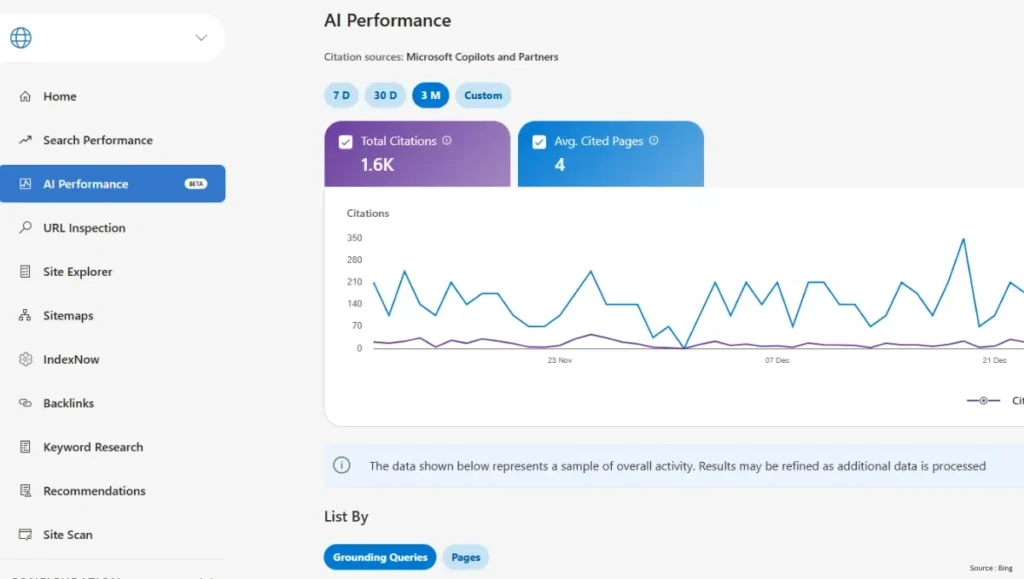
AI Performance Insights is a new reporting section in Bing Webmaster Tools that shows how often and where your content is used by Microsoft’s AI systems. Instead of focusing solely on clicks, impressions, or rankings, this report highlights AI citations — instances where Bing’s AI references your content while generating answers.

This includes visibility across:

  • Bing’s AI-powered search results
  • Microsoft Copilot responses
  • AI-generated summaries and contextual answers

For businesses already investing in SEO with a professional SEO agency in Dubai, this update provides clarity on whether their content is contributing to AI search results — even when users don’t click traditional blue links.

What’s New in the AI Performance Update?

The AI Performance report introduces several new data points that were previously unavailable in any webmaster tool.

1. Total AI Citations

This metric shows how many times your content was cited or referenced by AI systems within a selected date range. A higher citation count indicates stronger topical authority and trust.

2. Average Cited Pages

This highlights how many unique URLs from your website are referenced daily by AI results. It helps identify whether your authority is limited to one page or spread across multiple content assets.

3. Grounding Queries

Grounding queries reveal the actual search prompts that triggered AI systems to reference your content. This data is invaluable for content planning and topical expansion.

4. Page-Level AI Visibility

You can now see which specific pages are most frequently cited. This allows businesses to optimize high-performing pages further or replicate success across similar content.

5. Citation Trends Over Time

Trend analysis shows whether your AI visibility is improving or declining — making it easier to measure the impact of ongoing SEO improvements.

Read: The Real Reason Your Website Isn’t Appearing in AI Overviews

Why AI Performance Insights Matter More Than Rankings

Traditional SEO metrics focus on visibility in standard search results. However, AI search behaves differently. AI systems synthesize answers from trusted sources, often without sending direct traffic.

This update matters because:

  • AI citations signal content authority, not just optimization
  • Brands cited by AI gain credibility and brand recall
  • AI visibility influences future rankings and trust signals

For businesses working with advanced ai seo services, this report validates whether their optimization strategy aligns with how AI engines evaluate content.

How This Update Changes SEO Strategy

1. Keywords Alone Are No Longer Enough

AI systems prefer structured, comprehensive, and context-rich content. Thin pages optimized for single keywords are less likely to be cited.

This reinforces the need for content strategies built by experienced seo firms that understand topical depth, internal linking, and semantic relevance.

2. Internal Linking Becomes an AI Signal

Pages that are well-connected through logical internal links help AI systems understand site structure and authority.

3. Authority Is Built Across Clusters, Not Pages

AI favors content clusters that answer related questions comprehensively. This makes ongoing content expansion essential rather than one-off blog publishing.

How to Optimize for AI Performance Insights

To improve AI citation visibility, businesses should focus on the following:

Create AI-Friendly Content Structures

  • Clear headings
  • Direct answers under sub-sections
  • Bullet points and numbered steps
  • Supporting explanations instead of filler text

Strengthen Topical Authority

Publish multiple related articles around core services and interlink them naturally. For example, SquareZix supports this approach by combining SEO strategy with technical expertise from its website development company in Dubai ensuring content is technically sound and semantically optimized.

Maintain and Refresh Content

AI systems favor up-to-date content. Regular updates improve both citation potential and traditional rankings, especially when paired with professional website management services that ensure performance, security, and accuracy.

What AI Performance Insights Does Not Show (Yet)

While powerful, the report currently does not include:

  • Click data from AI results
  • Conversion tracking
  • Revenue attribution

However, AI citations are increasingly becoming top-of-funnel visibility signals, influencing brand discovery long before conversions happen.

Why Squarezix Is Built for AI-First SEO

At SquareZix, SEO is not treated as a checklist — it’s a system designed for modern search behavior. From technical optimization to content architecture and AI-ready strategies, SquareZix helps businesses stay visible across both traditional and AI-powered search experiences.

By combining SEO expertise with intelligent content planning and structured internal linking, we ensure your website is positioned for:

  • Higher AI citation frequency
  • Stronger topical authority
  • Long-term organic growth

Final Thoughts

The AI Performance Insights update in Bing Webmaster Tools confirms one thing clearly: search visibility is evolving. Rankings still matter, but authority, structure, and AI trust now play an equally critical role.

Businesses that adapt early — by investing in expert SEO strategy, structured content, and ongoing optimization — will dominate both traditional search results and AI-generated answers.

If you want your brand to be referenced, trusted, and visible in the next generation of search, SquareZix is already building for it.

Contact Today!

Why Duplicate Property Listings Confuse Google and Kill Rankings

In competitive property markets, visibility is everything. Yet many real estate businesses unknowingly sabotage their own rankings through duplicate listings. When the same property appears across multiple URLs with minimal variation, Google struggles to understand which page deserves priority. This is especially damaging for brands investing in seo services for real estate, because technical mistakes like duplication quietly erase hard-earned SEO gains before leads ever reach your website.

Duplicate property listings don’t just dilute rankings—they confuse search engines, weaken authority signals, and push serious buyers toward competitors with cleaner SEO structures.

Let’s break down why this happens, how it affects rankings, and what real estate businesses must do to fix it.

What Counts as a Duplicate Property Listing?

Duplicate listings occur when the same property appears on multiple pages with similar or identical content. This often happens due to:

  • Multiple URLs for the same property (filters, sorting, parameters)
  • Separate pages for rent vs sale with repeated descriptions
  • City, area, and project pages reusing the same listing text
  • CMS-generated duplicates created automatically
  • Old listings not removed after being sold or leased

While these may look harmless to users, to Google they appear as content redundancy, not relevance.

How Duplicate Listings Confuse Google’s Algorithm

Google’s goal is simple: show one best result for each search intent. Duplicate property pages break that logic in several ways.

1. Google Can’t Decide Which Page to Rank

When multiple pages contain the same listing content, Google doesn’t know which one is the “main” version. Instead of ranking one strongly, it often ranks none consistently.

2. Crawl Budget Is Wasted

Real estate websites can have hundreds—or thousands—of property URLs. Duplicate listings waste crawl budget, meaning important pages may not get indexed or updated properly.

3. Ranking Signals Are Split

Backlinks, internal links, and engagement signals get divided across duplicates instead of strengthening a single authoritative page.

Why This Problem Is Worse for Real Estate Websites

Real estate sites face unique SEO challenges that make duplication more harmful than in other industries.

Constantly Changing Inventory

Listings expire, update, and rotate frequently. Without proper management, old URLs remain live and compete with new ones.

Location-Based Pages Multiply Content

City, neighborhood, and project-based URLs often reuse the same listing descriptions, unintentionally creating large-scale duplication.

Heavy Use of Filters & Parameters

Price ranges, bedroom filters, and amenities often generate new URLs showing the same properties.

Without guidance from a professional SEO agency in Dubai, these structures silently erode visibility.

The Direct Impact on Rankings and Leads

Duplicate property listings don’t just hurt SEO—they hurt revenue.

  • Property pages stop ranking for high-intent keywords
  • Google favors aggregator portals over your website
  • Organic traffic drops despite having more listings
  • Leads shift toward competitors with cleaner site structures
  • Paid ads become the only reliable traffic source

This is why many seo companies for property management focus heavily on technical SEO before content creation—because content alone can’t fix structural duplication.

Why Google Trusts Clean Structures More Than More Listings

More pages don’t equal better rankings. In fact, Google increasingly rewards:

  • Clear canonical structures
  • Unique, intent-driven pages
  • Well-defined internal linking
  • Proper index control

AI-powered search systems now prioritize clarity over volume. If Google can’t confidently understand your site hierarchy, your listings lose visibility—even if the content quality is high.

How Duplicate Listings Affect AI Search & Overviews

AI-driven results rely on entity understanding, not keyword repetition.

Duplicate property pages send conflicting signals about:

  • Which property is primary
  • Which location page matters
  • Which URL should be cited

As a result, AI systems skip your site entirely in favor of competitors with structured, consolidated content.

This is one reason modern SEO strategies now combine technical fixes with intelligent content grouping—similar to approaches used in ecommerce seo services, where duplicate product pages are carefully managed to preserve rankings.

How to Fix Duplicate Property Listings the Right Way

1. Use Canonical URLs Strategically

Canonical tags tell Google which version of a listing is the primary one. This prevents ranking dilution.

2. Consolidate Similar Listings

Instead of multiple near-identical pages, use:

  • One main property page
  • Supporting area or category pages with unique content

3. Control Indexing

Not every filtered or parameter-based URL should be indexed. Proper noindex rules protect crawl budget.

4. Strengthen Internal Linking

Guide Google clearly using structured internal links from category, location, and blog pages.

This is where working with a professional SEO company in Dubai like SquareZix becomes critical.

Why Generic SEO Fixes Don’t Work for Real Estate

Real estate SEO isn’t just about keywords—it’s about architecture.

Generic SEO providers often:

  • Optimize titles without fixing duplication
  • Add blogs without resolving index conflicts
  • Focus on traffic instead of qualified buyer intent

SquareZix approaches real estate SEO with structure-first optimization, ensuring Google understands:

  • Which listings matter
  • Which pages represent authority
  • Which URLs deserve ranking power

How SquareZix Helps Real Estate Brands Win Rankings

At SquareZix, we don’t just optimize pages—we engineer clarity.

Our real estate SEO strategy includes:

  • Full duplicate content audits
  • Canonical and index optimization
  • Property page hierarchy planning
  • Location-based content structuring
  • AI-search–friendly SEO frameworks

By partnering with a specialized search engine optimization company, real estate brands reduce portal dependency and regain control over organic leads.

Final Takeaway

Duplicate property listings don’t help you rank more—they help competitors outrank you.

If Google is confused, rankings drop.
If rankings drop, leads disappear.
If leads disappear, portals win.

The solution isn’t more listings—it’s smarter SEO structure.

With SquareZix’s specialized real estate SEO strategies, your website becomes a trusted, authoritative source that Google—and buyers—can rely on.

Contact Today!

Why Ecommerce Websites Need Maintenance More Than Any Other Site

In the fast-paced world of ecommerce, a website is not just an online store—it’s your revenue engine. Unlike informational or service websites, ecommerce platforms handle payments, product catalogs, customer accounts, and a continuous influx of traffic. Even minor glitches can result in lost sales, frustrated customers, and long-term brand damage.

This is why ongoing website maintenance is critical for ecommerce stores. Businesses that treat their websites as a “launch and forget” project often face technical issues, SEO drops, and a poor user experience. As a leading website development company in Dubai, SquareZix provides specialized website maintenance services designed to keep ecommerce websites secure, fast, and optimized for conversions.

Ecommerce Websites Are Complex Systems

Ecommerce sites are significantly more complex than blogs, portfolios, or small business websites. They include:

  • Product catalogs with hundreds or thousands of SKUs
  • Shopping carts and checkout flows
  • Customer accounts, wishlists, and loyalty programs
  • Third-party integrations (payment gateways, CRM, inventory management)
  • Dynamic content like promotions, discounts, and product recommendations

Even small technical issues—like a plugin conflict, slow page load, or broken checkout button—can directly affect sales. This complexity makes ongoing website maintenance essential for ecommerce success.

Why Regular Maintenance Impacts Conversions

1. Prevents Checkout Errors

Nothing frustrates a customer more than encountering a failed payment or broken checkout button. With regular website maintenance, all integrations are tested, updated, and optimized, reducing cart abandonment and improving sales.

2. Keeps the Website Fast and Responsive

Site speed is critical for both conversions and SEO. Ecommerce pages with large images, scripts, or multiple plugins can slow down over time. SquareZix ensures your website stays fast, offering a seamless shopping experience on desktop and mobile devices.

3. Maintains Security and Trust

Ecommerce stores process sensitive data. Without ongoing updates, websites become vulnerable to hacks, malware, and data breaches. Our website maintenance services include security monitoring, software updates, and backups to protect your store and customer trust.

SEO Benefits of Ongoing Maintenance

Ecommerce websites need continuous optimization to perform well in search engines. Without maintenance:

  • Broken links can hurt rankings
  • Slow-loading product pages decrease visibility
  • Duplicate product URLs and outdated metadata can confuse search engines

At SquareZix, we combine website maintenance services with ecommerce SEO services, ensuring your site remains crawlable, fast, and optimized for both search engines and AI-driven results. This approach helps your store rank higher, attract more traffic, and convert more visitors into paying customers.

How Ongoing Maintenance Supports Growth

1. Product and Inventory Updates

Adding new products, updating prices, and managing promotions is continuous. Without proper maintenance, these updates can cause display issues, broken pages, or misaligned inventories, leading to customer frustration and lost sales.

2. Integration with New Tools

Ecommerce platforms constantly evolve. New plugins, AI-driven personalization tools, and third-party apps can enhance your store. Our team ensures all integrations work smoothly without conflicts.

3. Mobile Optimization

Mobile commerce is growing exponentially. Regular maintenance ensures that your ecommerce store remains responsive and user-friendly across devices, improving conversions and engagement.

4. Handling Traffic Spikes

Sales events, promotions, or seasonal traffic surges can overload unoptimized websites. Continuous maintenance ensures your ecommerce site scales to handle traffic spikes without crashing.

Why Businesses Partner with Squarezix

Ongoing website maintenance isn’t just about fixing issues—it’s about strategic growth. Squarezix offers tailored maintenance plans for ecommerce websites, including:

  • Security monitoring and updates
  • Speed and performance optimization
  • Plugin and theme updates
  • Regular backups and disaster recovery
  • UX and technical SEO optimization

By combining custom website development expertise with proactive maintenance, we ensure your ecommerce store not only functions flawlessly but continues to grow. Businesses that work with SquareZix can focus on marketing, sales, and customer engagement while we handle the technical backbone.

Explore our website maintenance services in Dubai to keep your ecommerce website safe, fast, and ready for conversions.

Conclusion

Ecommerce websites are unlike any other website—they are revenue-generating machines that require constant attention. A one-time launch is never enough. Ongoing website maintenance ensures your store remains secure, fast, and optimized, while preventing issues that could lead to lost revenue.

SquareZix, a trusted website development agency in Dubai, provides comprehensive website maintenance services tailored for ecommerce businesses. From performance optimization to security and SEO, our team ensures your online store stays ahead of the competition while maximizing conversions and customer trust.

Don’t risk downtime, slow performance, or lost sales. Partner with SquareZix and let us take care of your ecommerce website so you can focus on growing your business.

Why Single-Topic Pages Lose Leads to Competitor Content Clusters

Many businesses assume that creating single-topic pages—one page per keyword—is the best strategy for ranking on Google. While this approach may have worked in the early days of SEO, the digital landscape has evolved. Today, content clusters dominate search results, outperforming standalone pages in both rankings and conversions.

As a search engine optimization company in Dubai, we’ve seen countless businesses struggle with generating leads despite ranking for specific keywords. The missing link? Their content lacks depth, context, and the interconnected structure that modern SEO demands.

The Single-Topic Page Problem

A single-topic page focuses narrowly on one keyword or service. While it can rank for that exact phrase, it often fails to cover the broader user intent. This leads to multiple issues:

  • Limited context for AI search engines – AI-driven tools like Google’s AI Overviews prefer content that demonstrates authority across a topic cluster, not isolated pages.
  • Shallow user engagement – Users seeking comprehensive answers leave the page quickly when the content doesn’t address related questions.
  • Missed internal linking opportunities – Standalone pages are often not well-linked to related content, reducing their overall SEO authority.

Why Competitor Content Clusters Win

Content clusters organize multiple pages around a central pillar topic. This structure allows businesses to cover a topic comprehensively while signaling to search engines that they are an authority.

Competitors who use content clusters gain several advantages:

1. Enhanced Authority in Search Engines

When multiple pages cover related subtopics and link back to a central pillar page, search engines interpret this as topical authority. This increases the likelihood that your competitor appears in AI-driven summaries and featured snippets, even for queries you rank for individually.

2. Improved User Engagement

Content clusters provide users with a logical journey: they can navigate from general to specific subtopics without leaving your site. This reduces bounce rates, increases time on site, and improves lead capture opportunities.

3. SEO Scalability

Clusters allow your website to grow naturally. Adding new subtopics strengthens the pillar page rather than diluting SEO efforts across isolated pages. Over time, this creates a network of content that continues to attract traffic and leads without constant rewriting of single-topic pages.

How This Impacts Lead Generation

Single-topic pages often fail to convert because they focus solely on SEO rather than the user journey. Users land on the page for a keyword but may not find related answers, case studies, or calls-to-action.

For instance, a single-topic page targeting “Dubai SEO services” might rank but fails to guide visitors toward conversion. In contrast, a content cluster could include:

  • Pillar page: “Comprehensive SEO Solutions in Dubai”
  • Subpages: “Technical SEO Services in Dubai,” “Local SEO for Businesses in Dubai,” “AI SEO Services in Dubai
  • Internal links and CTAs guiding visitors to request a consultation

This structure not only improves rankings but also leads users naturally toward conversion. Businesses leveraging SEO agency in Dubai services with cluster-based strategies consistently see higher lead capture rates.

Role of AI in Content Clusters

Modern search engines and AI-driven systems like Google’s AI Overviews analyze contextual relationships between pages. Single-topic pages may rank individually but often fail to appear in AI-generated summaries or multi-intent queries.

Content clusters allow businesses to:

  • Establish topic authority, making AI systems trust your content
  • Improve semantic relevance, which helps in ranking for multiple related keywords
  • Drive high-intent traffic more effectively than isolated pages

For e-commerce businesses, leveraging ecommerce SEO services within a cluster ensures that product pages, category pages, and informational content all reinforce each other, improving both traffic and conversions.

How to Transition from Single-Topic Pages to Clusters

Step 1: Identify Pillar Topics

Choose overarching topics that align with your business goals. For example, “Digital Marketing Services in Dubai” can serve as a pillar topic.

Step 2: Map Subtopics

Identify related subtopics that answer specific questions or cover specialized services. Examples include “AI SEO Services in Dubai,” “Local SEO for Dubai Businesses,” or “E-commerce SEO Optimization.”

Step 3: Interlink Strategically

Link all subtopics back to the pillar page and vice versa. Ensure CTAs guide visitors toward conversion, such as consultation forms or service inquiries.

Step 4: Monitor & Optimize

Track performance using analytics. Adjust content depth, internal links, and CTAs to maximize both traffic and leads.

By following these steps, businesses can transition from isolated single-topic pages to a powerful content cluster, significantly improving both SEO and lead generation.

Why Businesses Need a Strategic SEO Partner

Implementing content clusters effectively requires expertise in on-page SEO, technical SEO, and conversion optimization. Partnering with a search engine optimization company in Dubai like SquareZix ensures that your website is structured for both AI search visibility and real human conversions.

Our team specializes in:

  • AI SEO to future-proof rankings
  • E-commerce SEO that boost product visibility and conversions
  • Structuring websites for scalable content clusters
  • Optimizing CTA placement across pages to maximize leads

Whether your goal is to outrank competitors, capture high-intent leads, or enhance AI-driven search visibility, strategic content clusters are a proven solution.

Final Thoughts

Single-topic pages may give short-term keyword wins, but in today’s SEO landscape, content clusters dominate rankings and lead generation. Businesses that invest in structured, interlinked content not only improve SEO but also convert visitors into paying clients more effectively.

If your website still relies heavily on isolated pages, it’s time to rethink your SEO strategy. Partner with a seo company in Dubai to implement a content cluster approach, leverage AI-driven insights, and generate measurable business growth.