Choosing the right e-commerce architecture is one of the most critical decisions for any online business. It directly impacts your website speed, scalability, user experience, and long-term growth.
Many businesses today struggle with a common question:
Should we stick to traditional e-commerce or switch to headless e-commerce?
If your online store is slow, difficult to scale, or limiting your design flexibility, the issue may not be your products or marketing—it may be your e-commerce architecture.
This guide breaks down Traditional vs Headless E-commerce, their differences, challenges, and how to choose the right one for your business.
Discover Our Expertise
Explore our company profile to learn more about our Digital Transformation Services, and how we can help your business thrive in the digital world.
The Core Problem: One Size Does Not Fit All Ecommerce Systems
Most businesses start with traditional e-commerce platforms because they are simple and quick to launch. However, as the business grows, limitations start appearing:
- Slow website performance
- Limited design flexibility
- Difficulty integrating modern tools
- Poor scalability during traffic spikes
On the other hand, headless e-commerce solves many of these issues—but it comes with its own complexity.
So how do you decide?
What Is Traditional Ecommerce?
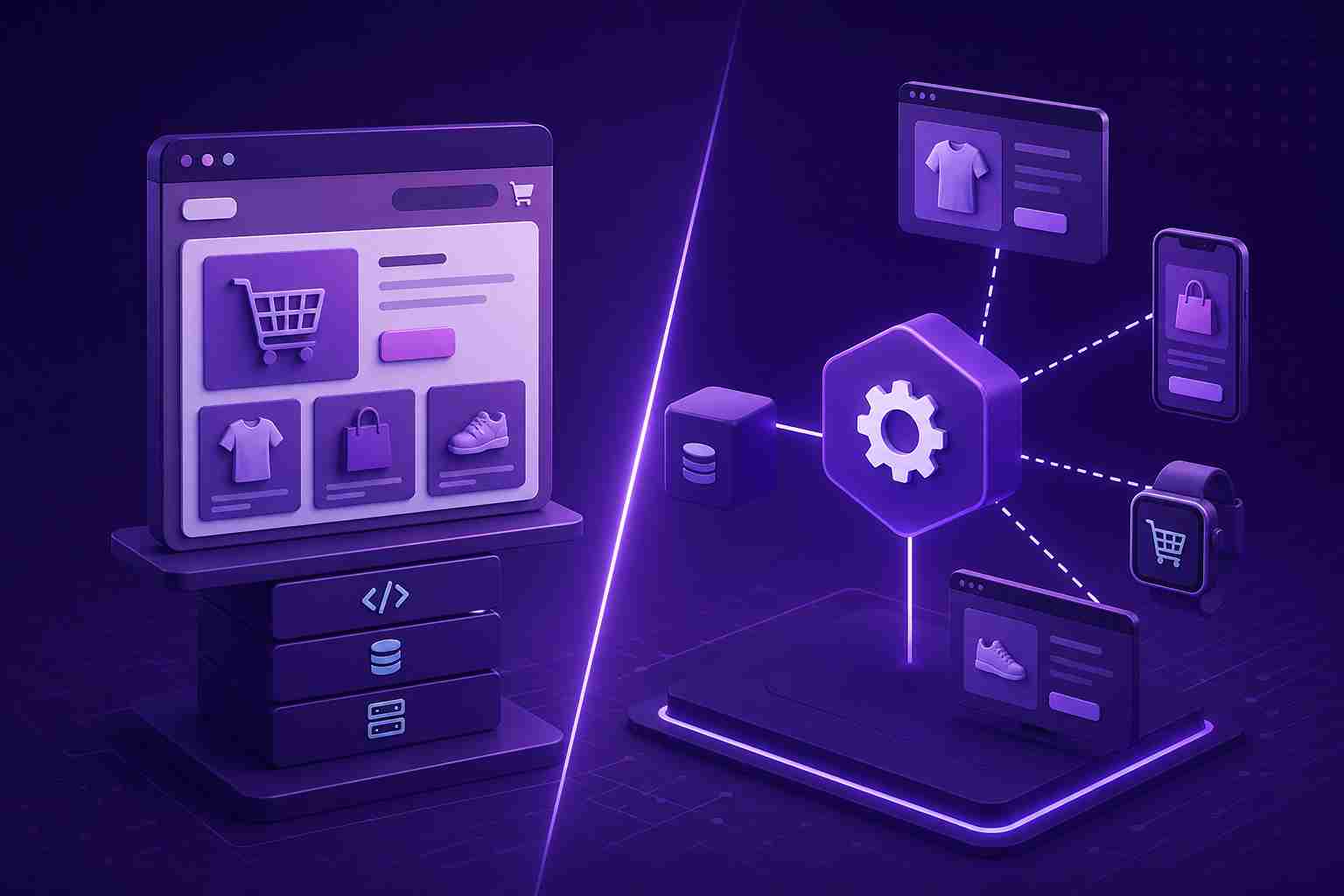
Traditional e-commerce (also called monolithic e-commerce) is a system where the frontend (what users see) and backend (where data and operations are managed) are tightly connected.
Popular examples:
- Shopify (standard setup)
- WooCommerce
- Magento (traditional setup)
Key Features:
- Built-in themes and templates
- Easy setup and management
- All-in-one system (frontend + backend together)
Limitations:
- Limited customization
- Slower performance under heavy load
- Difficult to scale advanced features
- Changes affect entire system
What Is Headless Ecommerce?
Headless ecommerce separates the frontend and backend. The backend manages data, while the frontend is built independently and communicates via APIs.
Key Features:
- Fully customizable frontend
- API-driven architecture
- Works across multiple platforms (web, mobile, apps, IoT)
- High scalability and flexibility
Popular technologies:
- Shopify Plus (Headless mode)
- CommerceTools
- BigCommerce (Headless)
- Custom frontend frameworks (React, Next.js)
Traditional vs Headless Ecommerce: Key Differences
1. Flexibility
Traditional: Limited design control
Headless: Fully customizable user experience
Problem solved: Brand uniqueness and UX limitations
2. Scalability
Traditional: Hard to scale complex features
Headless: Easily scalable across platforms and traffic spikes
Problem solved: Growth limitations
3. SEO and Marketing
Traditional: Basic SEO capabilities
Headless: Advanced SEO control with faster pages and better Core Web Vitals
Problem solved: Low search visibility and ranking issues
4. Development Complexity
Traditional: Easier for beginners
Headless: Requires technical expertise
Problem solved: Quick setup vs long-term flexibility trade-off
When Should You Choose Traditional Ecommerce?
Traditional e-commerce is suitable if:
- You are a startup or small business
- You need a quick and affordable setup
- You have simple product listings
- You don’t require advanced integrations
Best for: Small stores, local businesses, basic online shops
When Should You Choose Headless E-commerce?
Headless e-commerce is ideal if
- You need high performance and speed
- You want a fully custom design experience
- You plan to scale globally
- You require multi-platform integration (web + mobile apps)
- You want better SEO and conversion optimization
Best for: Growing brands, enterprise businesses, high-traffic e-commerce stores
The Business Impact: Why This Decision Matters
Choosing the wrong architecture can lead to:
- Lost conversions due to slow performance
- High maintenance costs
- Poor user experience
- Limited scalability during growth
Choosing the right one leads to:
- Faster websites
- Higher conversion rates
- Better SEO rankings
- Stronger brand experience
How SquareZix Helps
At SquareZix, we help businesses choose and build the right e-commerce architecture based on their goals—not just trends.
Our expertise includes:
- Headless e-commerce development
- Custom frontend solutions (React, Next.js)
- Scalable backend integrations
- Performance optimization
- SEO-focused e-commerce architecture
We don’t just build websites—we build high-performing digital commerce systems designed for growth.
Conclusion
The choice between traditional and headless e-commerce depends entirely on your business stage, goals, and scalability needs.
- If you want simplicity → Traditional e-commerce works
- If you want performance, flexibility, and future growth → Headless e-commerce is the better choice
In today’s competitive digital market, performance and user experience are no longer optional—they are essential for survival.
Frequently Asked Questions (FAQs)
1. What is the main difference between traditional and headless e-commerce?
Traditional e-commerce uses a single system where the frontend and backend are connected, while headless e-commerce separates both, allowing more flexibility, better performance, and custom user experiences.
2. Is headless ecommerce better for all businesses?
Not necessarily. Headless e-commerce is ideal for growing or enterprise-level businesses that need scalability and customization. Small businesses with simple needs may still find traditional e-commerce more suitable.
3. Does headless ecommerce improve website speed?
Yes. Since the frontend is built separately using modern technologies, headless ecommerce websites are generally faster and more optimized for performance compared to traditional setups.
4. Is traditional e-commerce easier to manage than headless e-commerce?
Yes. Traditional e-commerce platforms are easier to set up and manage, especially for beginners, because they come with built-in themes, plugins, and integrated systems.
5. Can I switch from traditional e-commerce to headless e-commerce later?
Yes. Many businesses start with traditional e-commerce and migrate to headless e-commerce as they grow and need better performance, flexibility, and scalability.