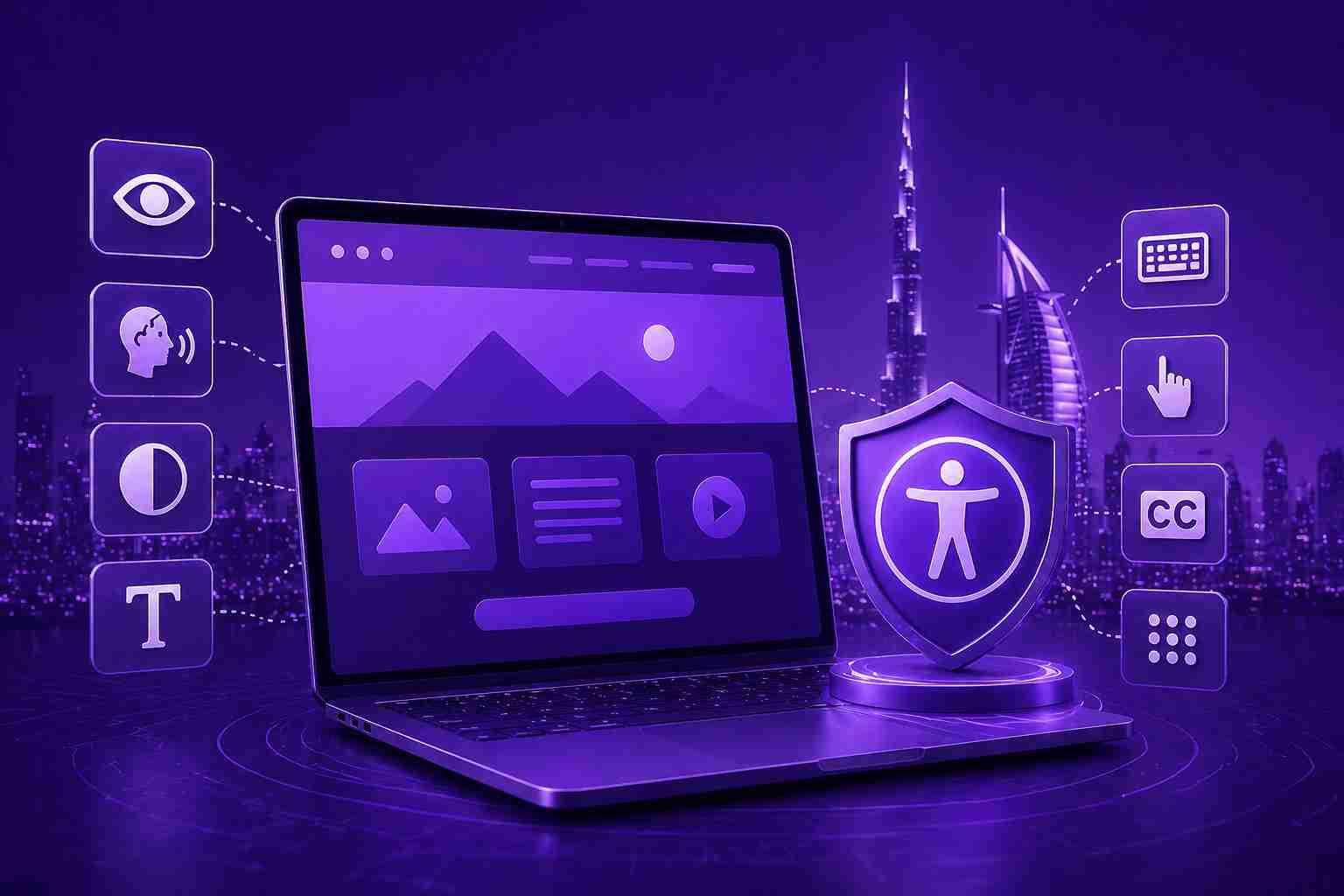
In 2026, having a beautiful website is no longer enough. If your website is difficult to use for people with disabilities, poor vision, hearing limitations, motor challenges, or cognitive differences, you may be losing customers every day.
For businesses in the UAE, website accessibility is no longer optional—it is becoming a business necessity, user expectation, and global best practice.
Whether you run an eCommerce store, corporate website, healthcare portal, school website, or government-related platform, ignoring WCAG accessibility standards can damage user experience, trust, and conversions.
In this guide, we explain why WCAG compliance matters for UAE websites, common mistakes businesses make, and how to fix them.
Discover Our Expertise
Explore our company profile to learn more about our Digital Transformation Services, and how we can help your business thrive in the digital world.
What Is WCAG?
WCAG stands for Web Content Accessibility Guidelines. These are internationally recognized standards created to make websites usable for everyone, including people with disabilities.
WCAG focuses on four principles:
- Perceivable – Users must be able to see or hear content
- Operable – Users must be able to navigate easily
- Understandable – Content should be clear and simple
- Robust – Websites should work with assistive technologies
These principles help businesses create inclusive digital experiences.
Why Accessibility Is Important for UAE Websites
The UAE is one of the world’s fastest-growing digital economies. Businesses are investing heavily in websites, eCommerce, apps, and online services.
But many websites still fail basic accessibility checks.
That creates barriers for:
- Users with visual impairments
- Elderly users
- Users with hearing difficulties
- Keyboard-only users
- Mobile users with temporary limitations
- Non-native language readers
An accessible website reaches more people and improves user satisfaction.
1. Accessibility Improves User Experience for Everyone
Accessibility is not only for people with disabilities.
Examples:
- Clear headings help all users scan pages faster
- Good contrast improves readability in sunlight
- Captions help users watching videos silently
- Bigger buttons improve mobile usability
- Keyboard navigation helps power users
Accessibility often equals better usability.
2. You May Be Losing Leads Without Realizing It
If users cannot fill forms, read text, or navigate menus, they leave.
That means:
- Higher bounce rates
- Lower conversions
- Poor trust signals
- Lost enquiries
- Missed sales opportunities
Many businesses blame marketing when the real issue is website usability.
3. Accessibility Supports SEO Performance
Many WCAG best practices also help SEO.
Examples:
- Proper heading structure
- Alt text for images
- Clear navigation
- Faster loading pages
- Mobile-friendly design
- Better content readability
Google rewards strong user experience, and accessibility contributes to it.
4. It Strengthens Brand Reputation
Modern customers expect businesses to be inclusive.
An accessible website shows:
- Professionalism
- Responsibility
- Attention to detail
- Customer-first thinking
This matters especially for healthcare, education, finance, and public-facing brands in the UAE.
5. Government and Enterprise Standards Are Increasing
Large organizations, public sector projects, and enterprise clients increasingly require vendors to meet accessibility expectations.
If your website fails basic compliance, you may lose tenders, partnerships, or procurement opportunities.
Accessibility can become a competitive advantage.
Common Accessibility Mistakes on UAE Websites
Many websites unknowingly have these issues:
- Low-color-contrast text
- Missing image alt text
- Buttons without labels
- No keyboard navigation
- Poor Arabic/English language switching
- Tiny fonts on mobile
- Auto-playing media
- Forms without error guidance
- PDF files that are unreadable by screen readers
These problems frustrate users and hurt performance.
Why Bilingual UAE Websites Need Extra Attention
Many UAE websites use both Arabic and English.
This creates additional accessibility needs:
- Correct right-to-left (RTL) layout for Arabic
- Clear font readability in both languages
- Proper language tags in code
- Consistent navigation between languages
- Equal access to all translated content
A bilingual site should be accessible in both versions.
What WCAG Level Should Businesses Target?
For most businesses, WCAG 2.1 AA is the common practical target.
This generally covers:
- Readable contrast
- Keyboard access
- Labels and forms
- Responsive layout
- Text alternatives
- Predictable navigation
It is a strong benchmark for modern business websites.
How to Improve Website Accessibility
Start with these steps:
1. Run an Accessibility Audit
Use manual testing plus tools to identify issues.
2. Fix Core UX Problems
Improve contrast, buttons, spacing, and navigation.
3. Optimize Forms
Make forms easy to complete with clear labels.
4. Add Alt Text
Describe important images meaningfully.
5. Test With Keyboard Only
Ensure users can navigate without a mouse.
6. Review Arabic + English Versions
Check accessibility in both languages.
Why Businesses Choose SquareZix
At SquareZix, we build websites that focus on SEO, speed, conversions, and accessibility. We help UAE businesses create modern websites that work for every visitor—not just some visitors.
From audits to redesigns, accessibility can be integrated into your website strategy from day one.
Final Thoughts
Accessibility is no longer a “nice to have.” It is part of professional web design in 2026.
If your UAE website is hard to use, hard to read, or hard to navigate, you are losing users and opportunities.
The best websites today are fast, mobile-friendly, SEO-ready, and accessible.
WCAG is no longer optional—it is the standard smart businesses are moving toward.
Frequently Asked Questions (FAQs)
1. What does WCAG mean?
WCAG stands for Web Content Accessibility Guidelines, an international standard for accessible websites.
2. Why is accessibility important for websites?
It helps all users navigate and use your website more easily, including people with disabilities.
3. Does accessibility help SEO?
Yes. Many accessibility improvements also improve SEO and user experience.
4. What is WCAG 2.1 AA?
It is a common compliance level that covers practical accessibility requirements for most business websites.
5. Are UAE businesses required to consider accessibility?
Many sectors increasingly expect it, especially enterprise, public-facing, and government-related projects.
6. Can bilingual Arabic websites have accessibility issues?
Yes. RTL layout, language switching, fonts, and translation consistency all matter.
7. How can I test if my website is accessible?
Start with an accessibility audit using automated tools plus manual expert testing.