
SquareZix Digital Marketing

How to Identify If Your Business Needs Professional SEO Help

In today’s competitive digital landscape, businesses often struggle to understand whether they truly need expert SEO support or if their current efforts are enough. If you’ve been searching for a SEO company in Dubai, chances are you’re already seeing signs that your online visibility isn’t where it should be.

SEO isn’t just about rankings — it’s about attracting the right audience, generating leads, and building long-term digital growth. This guide will help you clearly identify when it’s time to bring in professionals and how doing so can accelerate your business results.

Why Identifying the Need for SEO Early Matters

Many businesses wait until traffic drops or competitors dominate search results before investing in SEO. However, proactive optimization helps you:

  • Capture demand early
  • Reduce dependency on paid ads
  • Build brand authority
  • Improve conversion rates

The earlier you recognize the need for SEO, the faster you can gain a competitive advantage.

Key Signs Your Business Needs Professional SEO Help

1. Your Website Isn’t Ranking for Important Keywords

If your website doesn’t appear on the first page for services or products you offer, you’re missing potential customers.

This usually indicates:

  • Poor keyword targeting
  • Weak content strategy
  • Technical SEO issues

Professional SEO specialists conduct detailed audits to identify and fix these gaps.

2. You’re Getting Traffic but No Leads

Traffic alone doesn’t guarantee business growth. If visitors aren’t converting, your SEO strategy may lack intent optimization.

Common reasons include:

  • Wrong keyword targeting
  • Poor user experience
  • Weak calls-to-action
  • Content that doesn’t address user needs

This is where strategic optimization makes a major difference.3️⃣ Competitors Consistently Outrank You

If competitors dominate search results even with similar services, it’s a strong signal that they have a stronger SEO strategy.

They may be investing in:

  • Content clusters
  • Technical optimization
  • Authority building
  • Consistent updates

Working with an experienced team helps you close this gap faster.

4️⃣ Your Website Has Technical Issues

Technical SEO problems often go unnoticed but significantly impact rankings.

Examples include:

  • Slow page speed
  • Poor mobile usability
  • Broken internal linking
  • Indexing errors

Professionals identify and resolve these issues to ensure search engines can properly crawl and rank your site.5️⃣ You Rely Too Much on Paid Ads

If your lead generation depends entirely on advertising, it’s a sign your organic strategy needs improvement.

SEO helps you:

  • Lower acquisition costs
  • Generate consistent traffic
  • Build long-term visibility

Businesses that balance SEO with paid campaigns usually achieve better ROI.

When DIY SEO Isn’t Enough

While basic SEO practices can be implemented internally, scaling results requires deeper expertise, tools, and experience.

Professional teams provide:

  • Advanced keyword research
  • Competitive analysis
  • Content strategy planning
  • Technical audits
  • Performance tracking

This structured approach ensures sustainable growth rather than temporary gains.

How Professional SEO Transforms Business Performance

Improved Visibility

Your website appears in front of users actively searching for your services.

Higher Quality Leads

SEO targets intent-driven searches, resulting in more qualified prospects.

Better ROI

Organic traffic continues to generate leads long after optimization.

Stronger Brand Authority

Consistent visibility builds trust and credibility.

The Role of Modern SEO Strategies

Search is evolving rapidly with AI-driven experiences, semantic search, and intent-based ranking systems.

This is why many businesses are now adopting AI SEO services in Dubai to ensure their websites are optimized for both traditional search engines and AI-generated results.

Modern SEO focuses on:

  • Topical authority
  • Structured content
  • User intent
  • Technical performance

Staying ahead requires continuous optimization.

SEO Needs Differ by Business Type

Service Businesses

Focus on local SEO and lead generation.

Online Stores

Require strong product optimization and ecommerce seo services.

Enterprises

Need scalable strategies and advanced technical optimization.

Understanding your business model helps determine the right SEO approach.

Why Hiring an Agency Delivers Better Results

Working with an experienced seo agency in Dubai gives you access to a full team of specialists rather than relying on fragmented efforts.

Benefits include:

  • Comprehensive strategy
  • Faster implementation
  • Data-driven decisions
  • Continuous optimization
  • Measurable results

This collaborative approach ensures every aspect of your SEO works together toward your growth goals.

How to Decide If Now Is the Right Time

Ask yourself:

  • Are we visible for our core services?
  • Are we generating consistent organic leads?
  • Are competitors outranking us?
  • Do we have an SEO strategy in place?

If you answered “no” to any of these, it’s likely time to invest in professional support.

Why Businesses Choose SquareZix for SEO

Businesses partner with SquareZix because the focus isn’t just on rankings — it’s on measurable business growth.

The approach includes:
✔️ In-depth audits
✔️ Custom strategies
✔️ Content optimization
✔️ Technical improvements
✔️ Continuous monitoring

This ensures your website becomes a powerful acquisition channel.

If you’re ready to improve visibility and generate consistent leads, explore SquareZix’s SEO services in Dubai.

Final Thoughts

Recognizing when your business needs professional SEO help is the first step toward sustainable digital growth. If your website isn’t attracting the right traffic, converting leads, or competing effectively, investing in expert support can transform your results.

SEO is no longer optional — it’s a core component of modern marketing success.

Taking action now ensures your business stays competitive, visible, and positioned for long-term growth.

Contact us Today!

Freelancer vs SEO Agency: Which Is Right for Your Business?

Choosing the right SEO partner is one of the most important decisions a business can make when investing in digital growth. Many companies begin their search for a search engine optimization company in Dubai and quickly face a common dilemma — should they hire a freelancer or work with an agency?

While both options aim to improve search visibility, the level of expertise, scalability, and long-term impact can vary significantly. Understanding these differences will help you choose the path that delivers sustainable results rather than short-term fixes.

Freelancer vs SEO Agency: The Fundamental Difference

At a glance, freelancers and agencies may seem to offer similar services such as keyword research, on-page optimization, and reporting. The real difference lies in depth, structure, and strategic capability.

Freelancers typically:

  • Work independently
  • Specialize in limited areas
  • Handle fewer projects at a time

SEO agencies typically:

  • Provide a team of specialists
  • Follow proven processes
  • Align SEO with business goals

Businesses that want consistent growth usually benefit more from partnering with a professional seo agency in Dubai because of the structured and scalable approach.

When Hiring a Freelancer Makes Sense

Freelancers can be a practical option in specific situations:

  • Small businesses with tight budgets
  • Short-term SEO fixes
  • One-time audits
  • Early testing phase of marketing

However, as soon as your business starts scaling or entering competitive markets, the limitations of relying on one person often become clear.

Why Hiring an SEO Agency Is the Better Choice

1. Access to Multi-Disciplinary Expertise

SEO today involves far more than keywords. A strong strategy requires:

  • Technical SEO
  • Content planning
  • UX optimization
  • Data analytics
  • Conversion optimization

An agency provides specialists for each area, ensuring a comprehensive approach that a single freelancer typically cannot match.

2. Strategic Planning Instead of Task Execution

Freelancers often focus on executing tasks, while agencies build long-term strategies aligned with:

  • Revenue goals
  • Customer journey
  • Market positioning
  • Competitive analysis

This strategic alignment ensures SEO contributes directly to business growth rather than just traffic increases.

3. Scalability as Your Business Grows

As your website expands, you may need:

  • More content production
  • Technical improvements
  • Expansion into new keywords or markets

Agencies can scale resources quickly, while freelancers may struggle to handle increasing demands.

4. Better Reporting and Accountability

Professional agencies provide structured reporting with clear KPIs such as:

  • Traffic quality
  • Conversion metrics
  • Ranking trends
  • ROI insights

This transparency helps businesses make informed decisions and track progress confidently.

Cost Considerations: Short-Term Savings vs Long-Term ROI

Freelancers often appear cheaper upfront, but cost should always be evaluated against results.

Freelancer Investment

  • Lower monthly fees
  • Limited scope
  • Potential inconsistency

Agency Investment

  • Higher upfront cost
  • Comprehensive execution
  • Stronger ROI over time

Businesses focused on growth typically find agencies more cost-effective because they deliver measurable outcomes rather than isolated improvements.

How Modern SEO Complexity Favors Agencies

Search engines have evolved significantly, and modern SEO now involves advanced methodologies such as:

  • Intent-driven optimization
  • Semantic search modeling
  • Data-driven content strategies

Agencies are better equipped to implement these approaches, including advanced ai seo services in Dubai, helping businesses stay competitive as search becomes more intelligent. Industry-Specific Optimization Requires Broader Expertise

Certain industries require specialized SEO strategies. For example, online stores benefit from ecommerce seo services that optimize product structures, category hierarchies, and user journeys — an area where agency expertise becomes especially valuable.

Risk Factors of Choosing a Freelancer

While many freelancers are skilled, businesses should consider potential risks:

  • Limited availability
  • Single point of failure
  • Lack of diverse expertise
  • Difficulty managing complex projects

An agency mitigates these risks with a structured team and backup resources, ensuring continuity and reliability.

Performance Impact on Your Business

The right SEO company directly influences:

  • Lead generation
  • Brand authority
  • Search visibility
  • Customer acquisition cost
  • Revenue growth

Companies working with agencies often experience more stable and predictable growth because strategies are continuously optimized using data insights.

Why Businesses Transition From Freelancers to Agencies

Many companies start with freelancers but eventually move to agencies when they need:

  • Faster growth
  • Strategic direction
  • Broader expertise
  • Reliable execution

This transition happens because SEO becomes a core business function rather than a side activity.

Why SquareZix Is the Right SEO Partner

At SquareZix, SEO is treated as a business growth system rather than a checklist of tasks. The focus is on aligning search performance with measurable outcomes such as leads, conversions, and revenue.

By combining strategy, technical optimization, and data-driven insights, Squarezix helps businesses:

  • Increase qualified traffic
  • Improve conversion rates
  • Strengthen brand credibility
  • Achieve sustainable growth

Final Verdict: Freelancer or SEO Agency?

If your goal is a short-term solution or limited optimization, a freelancer might meet your needs.

However, if you want scalable growth, consistent results, and a competitive advantage, hiring an SEO agency is the smarter and safer investment.

SEO has become too complex and too important to rely on fragmented execution. Businesses that partner with a full-service agency position themselves for long-term success in an increasingly competitive digital landscape.

Contact us Today!

AI Performance Insights in Bing Webmaster Tools: New Update

Search is no longer just about rankings and clicks. With the rise of AI-driven search experiences like Microsoft Copilot and Bing’s generative answers, visibility now includes whether AI systems trust and reference your content. Recognizing this shift, Microsoft has introduced a major update — AI Performance Insights in Bing Webmaster Tools.

This update marks a turning point for businesses working with a forward-thinking search engine optimization company in Dubai, as it finally provides measurable data on how AI interacts with your website content. In this article, we’ll break down what the update includes, why it matters, and how businesses can use it to gain a competitive advantage.

What Is AI Performance Insights in Bing Webmaster Tools?

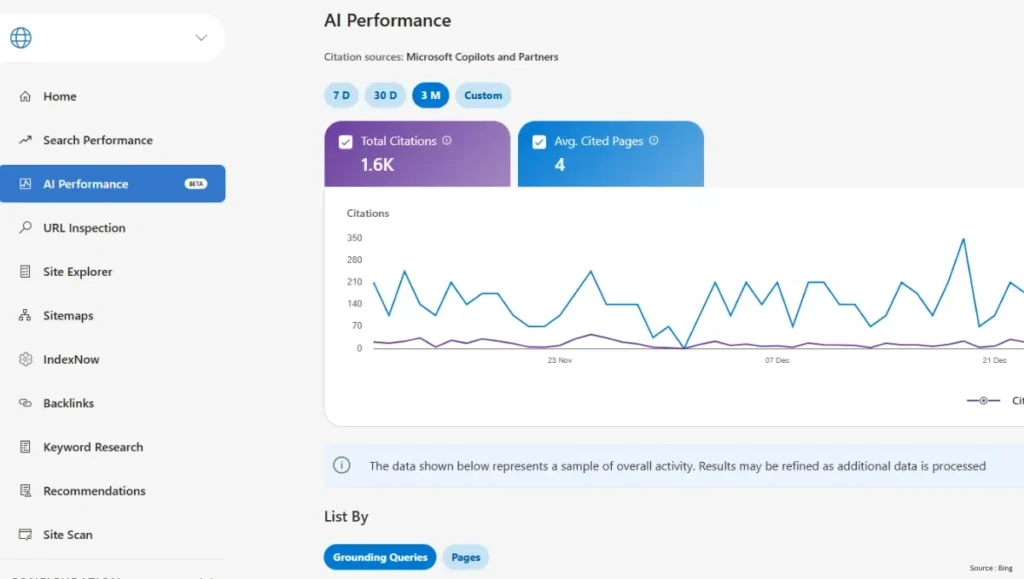
AI Performance Insights is a new reporting section in Bing Webmaster Tools that shows how often and where your content is used by Microsoft’s AI systems. Instead of focusing solely on clicks, impressions, or rankings, this report highlights AI citations — instances where Bing’s AI references your content while generating answers.

This includes visibility across:

  • Bing’s AI-powered search results
  • Microsoft Copilot responses
  • AI-generated summaries and contextual answers

For businesses already investing in SEO with a professional SEO agency in Dubai, this update provides clarity on whether their content is contributing to AI search results — even when users don’t click traditional blue links.

What’s New in the AI Performance Update?

The AI Performance report introduces several new data points that were previously unavailable in any webmaster tool.

1. Total AI Citations

This metric shows how many times your content was cited or referenced by AI systems within a selected date range. A higher citation count indicates stronger topical authority and trust.

2. Average Cited Pages

This highlights how many unique URLs from your website are referenced daily by AI results. It helps identify whether your authority is limited to one page or spread across multiple content assets.

3. Grounding Queries

Grounding queries reveal the actual search prompts that triggered AI systems to reference your content. This data is invaluable for content planning and topical expansion.

4. Page-Level AI Visibility

You can now see which specific pages are most frequently cited. This allows businesses to optimize high-performing pages further or replicate success across similar content.

5. Citation Trends Over Time

Trend analysis shows whether your AI visibility is improving or declining — making it easier to measure the impact of ongoing SEO improvements.

Read: The Real Reason Your Website Isn’t Appearing in AI Overviews

Why AI Performance Insights Matter More Than Rankings

Traditional SEO metrics focus on visibility in standard search results. However, AI search behaves differently. AI systems synthesize answers from trusted sources, often without sending direct traffic.

This update matters because:

  • AI citations signal content authority, not just optimization
  • Brands cited by AI gain credibility and brand recall
  • AI visibility influences future rankings and trust signals

For businesses working with advanced ai seo services, this report validates whether their optimization strategy aligns with how AI engines evaluate content.

How This Update Changes SEO Strategy

1. Keywords Alone Are No Longer Enough

AI systems prefer structured, comprehensive, and context-rich content. Thin pages optimized for single keywords are less likely to be cited.

This reinforces the need for content strategies built by experienced seo firms that understand topical depth, internal linking, and semantic relevance.

2. Internal Linking Becomes an AI Signal

Pages that are well-connected through logical internal links help AI systems understand site structure and authority.

3. Authority Is Built Across Clusters, Not Pages

AI favors content clusters that answer related questions comprehensively. This makes ongoing content expansion essential rather than one-off blog publishing.

How to Optimize for AI Performance Insights

To improve AI citation visibility, businesses should focus on the following:

Create AI-Friendly Content Structures

  • Clear headings
  • Direct answers under sub-sections
  • Bullet points and numbered steps
  • Supporting explanations instead of filler text

Strengthen Topical Authority

Publish multiple related articles around core services and interlink them naturally. For example, SquareZix supports this approach by combining SEO strategy with technical expertise from its website development company in Dubai ensuring content is technically sound and semantically optimized.

Maintain and Refresh Content

AI systems favor up-to-date content. Regular updates improve both citation potential and traditional rankings, especially when paired with professional website management services that ensure performance, security, and accuracy.

What AI Performance Insights Does Not Show (Yet)

While powerful, the report currently does not include:

  • Click data from AI results
  • Conversion tracking
  • Revenue attribution

However, AI citations are increasingly becoming top-of-funnel visibility signals, influencing brand discovery long before conversions happen.

Why Squarezix Is Built for AI-First SEO

At SquareZix, SEO is not treated as a checklist — it’s a system designed for modern search behavior. From technical optimization to content architecture and AI-ready strategies, SquareZix helps businesses stay visible across both traditional and AI-powered search experiences.

By combining SEO expertise with intelligent content planning and structured internal linking, we ensure your website is positioned for:

  • Higher AI citation frequency
  • Stronger topical authority
  • Long-term organic growth

Final Thoughts

The AI Performance Insights update in Bing Webmaster Tools confirms one thing clearly: search visibility is evolving. Rankings still matter, but authority, structure, and AI trust now play an equally critical role.

Businesses that adapt early — by investing in expert SEO strategy, structured content, and ongoing optimization — will dominate both traditional search results and AI-generated answers.

If you want your brand to be referenced, trusted, and visible in the next generation of search, SquareZix is already building for it.

Contact Today!

Why Duplicate Property Listings Confuse Google and Kill Rankings

In competitive property markets, visibility is everything. Yet many real estate businesses unknowingly sabotage their own rankings through duplicate listings. When the same property appears across multiple URLs with minimal variation, Google struggles to understand which page deserves priority. This is especially damaging for brands investing in seo services for real estate, because technical mistakes like duplication quietly erase hard-earned SEO gains before leads ever reach your website.

Duplicate property listings don’t just dilute rankings—they confuse search engines, weaken authority signals, and push serious buyers toward competitors with cleaner SEO structures.

Let’s break down why this happens, how it affects rankings, and what real estate businesses must do to fix it.

What Counts as a Duplicate Property Listing?

Duplicate listings occur when the same property appears on multiple pages with similar or identical content. This often happens due to:

  • Multiple URLs for the same property (filters, sorting, parameters)
  • Separate pages for rent vs sale with repeated descriptions
  • City, area, and project pages reusing the same listing text
  • CMS-generated duplicates created automatically
  • Old listings not removed after being sold or leased

While these may look harmless to users, to Google they appear as content redundancy, not relevance.

How Duplicate Listings Confuse Google’s Algorithm

Google’s goal is simple: show one best result for each search intent. Duplicate property pages break that logic in several ways.

1. Google Can’t Decide Which Page to Rank

When multiple pages contain the same listing content, Google doesn’t know which one is the “main” version. Instead of ranking one strongly, it often ranks none consistently.

2. Crawl Budget Is Wasted

Real estate websites can have hundreds—or thousands—of property URLs. Duplicate listings waste crawl budget, meaning important pages may not get indexed or updated properly.

3. Ranking Signals Are Split

Backlinks, internal links, and engagement signals get divided across duplicates instead of strengthening a single authoritative page.

Why This Problem Is Worse for Real Estate Websites

Real estate sites face unique SEO challenges that make duplication more harmful than in other industries.

Constantly Changing Inventory

Listings expire, update, and rotate frequently. Without proper management, old URLs remain live and compete with new ones.

Location-Based Pages Multiply Content

City, neighborhood, and project-based URLs often reuse the same listing descriptions, unintentionally creating large-scale duplication.

Heavy Use of Filters & Parameters

Price ranges, bedroom filters, and amenities often generate new URLs showing the same properties.

Without guidance from a professional SEO agency in Dubai, these structures silently erode visibility.

The Direct Impact on Rankings and Leads

Duplicate property listings don’t just hurt SEO—they hurt revenue.

  • Property pages stop ranking for high-intent keywords
  • Google favors aggregator portals over your website
  • Organic traffic drops despite having more listings
  • Leads shift toward competitors with cleaner site structures
  • Paid ads become the only reliable traffic source

This is why many seo companies for property management focus heavily on technical SEO before content creation—because content alone can’t fix structural duplication.

Why Google Trusts Clean Structures More Than More Listings

More pages don’t equal better rankings. In fact, Google increasingly rewards:

  • Clear canonical structures
  • Unique, intent-driven pages
  • Well-defined internal linking
  • Proper index control

AI-powered search systems now prioritize clarity over volume. If Google can’t confidently understand your site hierarchy, your listings lose visibility—even if the content quality is high.

How Duplicate Listings Affect AI Search & Overviews

AI-driven results rely on entity understanding, not keyword repetition.

Duplicate property pages send conflicting signals about:

  • Which property is primary
  • Which location page matters
  • Which URL should be cited

As a result, AI systems skip your site entirely in favor of competitors with structured, consolidated content.

This is one reason modern SEO strategies now combine technical fixes with intelligent content grouping—similar to approaches used in ecommerce seo services, where duplicate product pages are carefully managed to preserve rankings.

How to Fix Duplicate Property Listings the Right Way

1. Use Canonical URLs Strategically

Canonical tags tell Google which version of a listing is the primary one. This prevents ranking dilution.

2. Consolidate Similar Listings

Instead of multiple near-identical pages, use:

  • One main property page
  • Supporting area or category pages with unique content

3. Control Indexing

Not every filtered or parameter-based URL should be indexed. Proper noindex rules protect crawl budget.

4. Strengthen Internal Linking

Guide Google clearly using structured internal links from category, location, and blog pages.

This is where working with a professional SEO company in Dubai like SquareZix becomes critical.

Why Generic SEO Fixes Don’t Work for Real Estate

Real estate SEO isn’t just about keywords—it’s about architecture.

Generic SEO providers often:

  • Optimize titles without fixing duplication
  • Add blogs without resolving index conflicts
  • Focus on traffic instead of qualified buyer intent

SquareZix approaches real estate SEO with structure-first optimization, ensuring Google understands:

  • Which listings matter
  • Which pages represent authority
  • Which URLs deserve ranking power

How SquareZix Helps Real Estate Brands Win Rankings

At SquareZix, we don’t just optimize pages—we engineer clarity.

Our real estate SEO strategy includes:

  • Full duplicate content audits
  • Canonical and index optimization
  • Property page hierarchy planning
  • Location-based content structuring
  • AI-search–friendly SEO frameworks

By partnering with a specialized search engine optimization company, real estate brands reduce portal dependency and regain control over organic leads.

Final Takeaway

Duplicate property listings don’t help you rank more—they help competitors outrank you.

If Google is confused, rankings drop.
If rankings drop, leads disappear.
If leads disappear, portals win.

The solution isn’t more listings—it’s smarter SEO structure.

With SquareZix’s specialized real estate SEO strategies, your website becomes a trusted, authoritative source that Google—and buyers—can rely on.

Contact Today!

Why Single-Topic Pages Lose Leads to Competitor Content Clusters

Many businesses assume that creating single-topic pages—one page per keyword—is the best strategy for ranking on Google. While this approach may have worked in the early days of SEO, the digital landscape has evolved. Today, content clusters dominate search results, outperforming standalone pages in both rankings and conversions.

As a search engine optimization company in Dubai, we’ve seen countless businesses struggle with generating leads despite ranking for specific keywords. The missing link? Their content lacks depth, context, and the interconnected structure that modern SEO demands.

The Single-Topic Page Problem

A single-topic page focuses narrowly on one keyword or service. While it can rank for that exact phrase, it often fails to cover the broader user intent. This leads to multiple issues:

  • Limited context for AI search engines – AI-driven tools like Google’s AI Overviews prefer content that demonstrates authority across a topic cluster, not isolated pages.
  • Shallow user engagement – Users seeking comprehensive answers leave the page quickly when the content doesn’t address related questions.
  • Missed internal linking opportunities – Standalone pages are often not well-linked to related content, reducing their overall SEO authority.

Why Competitor Content Clusters Win

Content clusters organize multiple pages around a central pillar topic. This structure allows businesses to cover a topic comprehensively while signaling to search engines that they are an authority.

Competitors who use content clusters gain several advantages:

1. Enhanced Authority in Search Engines

When multiple pages cover related subtopics and link back to a central pillar page, search engines interpret this as topical authority. This increases the likelihood that your competitor appears in AI-driven summaries and featured snippets, even for queries you rank for individually.

2. Improved User Engagement

Content clusters provide users with a logical journey: they can navigate from general to specific subtopics without leaving your site. This reduces bounce rates, increases time on site, and improves lead capture opportunities.

3. SEO Scalability

Clusters allow your website to grow naturally. Adding new subtopics strengthens the pillar page rather than diluting SEO efforts across isolated pages. Over time, this creates a network of content that continues to attract traffic and leads without constant rewriting of single-topic pages.

How This Impacts Lead Generation

Single-topic pages often fail to convert because they focus solely on SEO rather than the user journey. Users land on the page for a keyword but may not find related answers, case studies, or calls-to-action.

For instance, a single-topic page targeting “Dubai SEO services” might rank but fails to guide visitors toward conversion. In contrast, a content cluster could include:

  • Pillar page: “Comprehensive SEO Solutions in Dubai”
  • Subpages: “Technical SEO Services in Dubai,” “Local SEO for Businesses in Dubai,” “AI SEO Services in Dubai
  • Internal links and CTAs guiding visitors to request a consultation

This structure not only improves rankings but also leads users naturally toward conversion. Businesses leveraging SEO agency in Dubai services with cluster-based strategies consistently see higher lead capture rates.

Role of AI in Content Clusters

Modern search engines and AI-driven systems like Google’s AI Overviews analyze contextual relationships between pages. Single-topic pages may rank individually but often fail to appear in AI-generated summaries or multi-intent queries.

Content clusters allow businesses to:

  • Establish topic authority, making AI systems trust your content
  • Improve semantic relevance, which helps in ranking for multiple related keywords
  • Drive high-intent traffic more effectively than isolated pages

For e-commerce businesses, leveraging ecommerce SEO services within a cluster ensures that product pages, category pages, and informational content all reinforce each other, improving both traffic and conversions.

How to Transition from Single-Topic Pages to Clusters

Step 1: Identify Pillar Topics

Choose overarching topics that align with your business goals. For example, “Digital Marketing Services in Dubai” can serve as a pillar topic.

Step 2: Map Subtopics

Identify related subtopics that answer specific questions or cover specialized services. Examples include “AI SEO Services in Dubai,” “Local SEO for Dubai Businesses,” or “E-commerce SEO Optimization.”

Step 3: Interlink Strategically

Link all subtopics back to the pillar page and vice versa. Ensure CTAs guide visitors toward conversion, such as consultation forms or service inquiries.

Step 4: Monitor & Optimize

Track performance using analytics. Adjust content depth, internal links, and CTAs to maximize both traffic and leads.

By following these steps, businesses can transition from isolated single-topic pages to a powerful content cluster, significantly improving both SEO and lead generation.

Why Businesses Need a Strategic SEO Partner

Implementing content clusters effectively requires expertise in on-page SEO, technical SEO, and conversion optimization. Partnering with a search engine optimization company in Dubai like SquareZix ensures that your website is structured for both AI search visibility and real human conversions.

Our team specializes in:

  • AI SEO to future-proof rankings
  • E-commerce SEO that boost product visibility and conversions
  • Structuring websites for scalable content clusters
  • Optimizing CTA placement across pages to maximize leads

Whether your goal is to outrank competitors, capture high-intent leads, or enhance AI-driven search visibility, strategic content clusters are a proven solution.

Final Thoughts

Single-topic pages may give short-term keyword wins, but in today’s SEO landscape, content clusters dominate rankings and lead generation. Businesses that invest in structured, interlinked content not only improve SEO but also convert visitors into paying clients more effectively.

If your website still relies heavily on isolated pages, it’s time to rethink your SEO strategy. Partner with a seo company in Dubai to implement a content cluster approach, leverage AI-driven insights, and generate measurable business growth.

Why Content Clusters Matter More Than Keywords in AI Search Results

Search has fundamentally changed. With Google’s AI Overviews, generative search, and LLM-driven discovery, ranking is no longer about stuffing pages with keywords. Today, topical authority and content relationships matter far more than isolated keyword targeting. For businesses working with a search engine optimization company in dubai, understanding why content clusters outperform traditional keyword strategies is now critical for sustainable visibility.

This shift is especially relevant for competitive markets like Dubai, where AI-driven search engines prioritize context, depth, and credibility over surface-level optimization.

What Are Content Clusters (And Why AI Loves Them)

A content cluster is a structured group of related pages built around a central topic rather than a single keyword. It usually consists of:

  • A pillar page (broad, authoritative)
  • Supporting cluster pages (deep dives into subtopics)
  • Strategic internal linking between them

AI search systems don’t read pages the way humans do. They map relationships between concepts, identify topical depth, and evaluate how comprehensively a brand covers a subject.

This is where content clusters outperform standalone keyword pages—they provide semantic completeness, not just keyword presence.

Why Keywords Alone Are Losing Power in AI Search

Traditional SEO focused heavily on ranking for one keyword per page. But AI-powered search engines now understand:

  • Synonyms and intent
  • Contextual meaning
  • Topic coverage across multiple URLs
  • Brand-level authority signals

This means a single well-optimized page targeting one keyword can still lose to a website that demonstrates topical expertise across multiple interconnected pages.

Many businesses working with traditional seo firms still rely on outdated keyword-first approaches, which struggle to perform in AI-driven results.

How Content Clusters Improve AI Overview Visibility

AI Overviews don’t pull answers from just one page. They synthesize information from multiple authoritative sources. Content clusters help because they:

  1. Signal topical authority
  2. Provide structured internal references
  3. Reinforce expertise across related queries

When your site consistently covers a topic from different angles, AI systems are more confident using your content as a reference point.

This is one of the core strategies used by advanced agencies offering ai seo services in Dubai—not just ranking pages, but positioning brands as knowledge hubs.

Content Clusters vs Keyword Pages: A Practical Example

Let’s take SEO services as an example.

Old approach:

  • One page optimized for “SEO agency Dubai
  • Minor blog posts loosely related

Modern cluster-based approach:

  • Pillar page explaining SEO strategy and methodology
  • Supporting articles on:
    • Technical SEO issues
    • Content architecture
    • AI-driven search changes
    • Local SEO challenges in Dubai
  • Strong internal links back to a central SEO service page

When done correctly, the pillar page naturally strengthens the visibility of the entire cluster, including the commercial service page. This is why businesses often see better results when they work with an experienced SEO agency in Dubai that understands content architecture, not just keywords.

Internal Linking: The Backbone of Content Clusters

Content clusters only work when internal linking is intentional.

Strategic internal links:

  • Guide AI crawlers through topic relationships
  • Distribute authority across pages
  • Improve crawl efficiency
  • Increase user engagement signals

For example, informational articles should naturally link back to a core service page using contextual anchor text like SEO agency in Dubai, reinforcing both relevance and conversion intent.

This internal structure helps AI models understand which page represents your core expertise.

Why Content Clusters Drive Better Business Results (Not Just Rankings)

Beyond search visibility, content clusters:

  • Increase average session duration
  • Reduce bounce rates
  • Improve lead quality
  • Build long-term brand trust

When users land on one article and seamlessly move to related content, it signals content satisfaction—a key behavioral signal for AI-based ranking systems.

More importantly, cluster-driven SEO attracts high-intent users who are researching deeply before converting.

How Squarezix Builds AI-Ready Content Clusters

At SquareZix, content is not created in isolation. Every article is mapped to a broader topical framework designed to support long-term authority and AI discoverability.

As a performance-focused search engine optimization company in Dubai, SquareZix emphasizes:

  • Topic-first planning instead of keyword stuffing
  • Semantic SEO and entity-based optimization
  • Intent-driven internal linking
  • Content designed for both humans and LLMs

This approach ensures your brand is not just visible today—but remains relevant as AI search evolves.

The Future of SEO Is Topic Ownership, Not Keyword Ownership

AI search engines are moving toward answer engines, not result pages. Brands that win will be those that:

  • Own topics, not keywords
  • Publish depth, not volume
  • Build structured content ecosystems
  • Align content with real user intent

Content clusters are no longer optional—they are foundational for sustainable SEO success.

If your website still relies on scattered keyword pages, you’re competing at a disadvantage in AI-driven search.

Final Thoughts

Keywords still matter—but only within a larger, intelligently connected content framework. Content clusters give AI systems the clarity, depth, and authority they need to trust your brand.

For businesses in competitive markets like Dubai, partnering with the right SEO experts can mean the difference between disappearing in AI results—or becoming the source AI relies on.

Contact SquareZix today!

How URL Logic Confuses Google More Than Broken Links

Most businesses panic when they discover broken links on their website. While broken links are a problem, there’s a far more damaging issue that often goes unnoticed: poor URL logic. In fact, confusing URL structures can harm rankings, indexing, and crawl efficiency more than a few broken links ever will.

For any search engine optimization company in Dubai, URL logic is a foundational ranking signal. When Google can’t understand how your pages relate to each other, it struggles to assign relevance, authority, and trust—no matter how good your content is.

What Is URL Logic (And Why Google Cares So Much)

URL logic refers to how your website URLs are structured, organized, and connected. A logical URL structure helps search engines understand:

  • Page hierarchy
  • Topic relationships
  • Content depth
  • Which pages matter most

For example, a clean structure like:
/services/seo/technical-seo/
clearly signals topical relevance and hierarchy.

But when URLs are messy, inconsistent, or randomly generated, Google has to guess. And when Google guesses, rankings suffer.

Why Broken Links Are Easier for Google to Handle

Broken links are obvious. Google detects them quickly and either:

  • Ignores them
  • Devalues the link
  • Removes the page from the crawl path

They’re isolated issues.

URL logic problems, however, are systemic. They affect how Google crawls and interprets your entire website.

This is why many websites with “no major errors” still fail to rank—they’re structurally confusing.

Common URL Logic Mistakes That Confuse Google

1. Inconsistent URL Structures

When similar pages follow different URL patterns, Google can’t confidently group them.

Example:

  • /seo-services/
  • /services-search-engine-optimization/
  • /seo-dubai-page/

To humans, these look related. To Google, they look like separate topics competing with each other.

2. Overuse of Parameters and Dynamic URLs

URLs filled with parameters (?id=123&ref=abc) create duplicate versions of the same page.

Google then has to decide:

  • Which version to index
  • Which one deserves ranking signals

Often, the wrong one wins—or none do.

3. Flat URLs With No Hierarchy

A flat structure like:

  • /seo
  • /ppc
  • /blog1
  • /page-new

gives Google no context.

Without hierarchy, Google can’t understand:

  • Which pages support others
  • Which pages are category leaders

This weakens topical authority and limits ranking potential.

4. Keyword Stuffed URLs That Break Semantics

Some websites try to “optimize” URLs by stuffing keywords unnaturally.

Example:
/best-seo-agency-dubai-cheap-affordable-top-company/

Instead of helping, this:

  • Triggers spam signals
  • Reduces trust
  • Confuses AI-driven ranking systems

Modern SEO values clarity, not excess.

How Poor URL Logic Hurts Crawl Efficiency

Google allocates a crawl budget—even to small websites.

When URL logic is weak:

  • Google wastes time crawling duplicates
  • Important pages are crawled less often
  • New pages take longer to index

This is especially damaging for growing businesses publishing new content or service pages regularly.

Professional seo firms focus heavily on crawl efficiency because it directly impacts visibility and speed to rank.

URL Logic vs Internal Linking: Why Structure Comes First

Internal links are important—but they can’t fix broken logic.

If URLs don’t clearly communicate hierarchy:

  • Internal links send mixed signals
  • Authority gets diluted
  • Pages cannibalize each other

Think of URL logic as the skeleton, and internal links as the muscles. Strong muscles can’t compensate for a broken skeleton.

Why AI Search Is Even Less Forgiving About URL Logic

With the rise of AI-driven search and Google AI Overviews, structure matters more than ever.

AI systems analyze:

  • URL patterns
  • Topic clusters
  • Semantic relationships

If your URLs don’t reflect clean topical organization, AI systems struggle to trust and reference your content—regardless of quality.

This is where ai seo services become critical, as they focus on semantic clarity, not just keyword placement.

Real-World Example: Why Pages Stay Indexed but Never Rank

Many businesses face this issue:

“Our pages are indexed, but they never show up.”

In most cases, the problem isn’t content—it’s URL logic.

Google indexes the page, but:

  • Can’t assign it a clear role
  • Can’t determine authority
  • Can’t connect it to a topic cluster

Result: the page exists, but it’s invisible.

How a Professional SEO Strategy Fixes URL Logic

A structured SEO approach includes:

  • URL hierarchy mapping
  • Canonical strategy implementation
  • Redirect cleanup
  • Topic-based folder structures
  • Crawl path optimization

This is a core part of technical SEO handled by experienced teams like a trusted SEO agency in Dubai—not something plugins can fix automatically.

Broken Links Still Matter

Broken links are visible problems. URL logic issues are invisible killers.

If you fix broken links but ignore structure:

  • Rankings won’t improve
  • Crawl efficiency won’t recover
  • Authority won’t consolidate

URL logic creates the foundation that allows every other SEO effort to work.

Final Thoughts: Clean URLs = Clear Signals

Google doesn’t rank confusion.

When your URL logic is clear:

  • Crawling becomes efficient
  • Authority flows correctly
  • AI systems understand your site
  • Rankings become more stable

If your website has grown organically over time—new pages, new services, multiple campaigns—there’s a high chance URL logic is holding you back.

Fixing it isn’t glamorous, but it’s one of the most powerful SEO improvements you can make.

To rank first on google, contact us today!

How Google AI Overviews Choose Which Brands to Trust

Google search is no longer just about ranking blue links. With the rise of AI Overviews, Google now decides which brands it trusts enough to summarize, quote, and recommend directly. If your website isn’t being referenced, it’s not just an SEO issue—it’s a trust issue.

As a search engine optimization company in Dubai, we see this shift daily. Brands that once ranked well are now invisible in AI-generated answers, while others dominate despite having fewer pages. Understanding how Google’s AI decides trust is the difference between future visibility and digital decline.

What Google AI Overviews Actually Do

AI Overviews are designed to:

  • Answer complex questions instantly
  • Reduce low-quality search results
  • Highlight sources Google believes are accurate, authoritative, and reliable

Google’s AI does not “rank pages” the old way. It evaluates brands, patterns, and signals across your entire website.

If your brand doesn’t pass these checks, your content may never be surfaced—no matter how optimized it looks on the surface.

1. Brand Consistency Is the New Ranking Factor

Google AI prioritizes brands that are consistent everywhere:

  • Website content
  • Service pages
  • Blog topics
  • Internal linking structure

If your website talks about SEO in one tone, PPC in another, and branding with no connection between them, AI sees fragmentation—not authority.

A properly structured site supported by professional SEO agency services in Dubai creates topical clarity that AI systems can confidently reference.

2. Topical Authority Beats Keyword Volume

AI Overviews reward brands that:

  • Cover a topic deeply
  • Explain relationships between subtopics
  • Answer follow-up questions naturally

Publishing one article on SEO is not enough. Google AI looks for clusters of knowledge, not isolated posts.

That’s why businesses working with established seo firms outperform competitors with more content but less structure.

3. Internal Linking Signals Trust to AI Systems

AI Overviews analyze how your pages connect:

  • Which pages support others
  • How services link to educational content
  • Whether users can navigate logically

Strong internal linking shows Google that:

  • You understand your own expertise
  • Your content hierarchy makes sense
  • Your website was built intentionally

For example, linking informative SEO content back to a professional SEO service page strengthens brand authority across the entire site.

4. Experience Signals Matter More Than Ever

Google AI evaluates real-world experience indicators such as:

  • Case-style explanations
  • Industry-specific insights
  • Practical examples (without fluff)

Generic SEO advice doesn’t build trust anymore. AI Overviews prefer brands that demonstrate applied knowledge, not recycled tactics.

This is where advanced AI SEO services in Dubai help brands reframe content to match how machine learning models interpret expertise.

5. Technical Structure Directly Impacts Trust

If AI struggles to interpret your site, it won’t trust it.

Key technical signals include:

  • Clear heading hierarchy
  • Fast page load speeds
  • Mobile-first usability
  • Clean URL structures
  • Schema markup for services

Google AI doesn’t guess—it reads patterns. Technical SEO is no longer optional; it’s foundational.

6. Entity Recognition: Google Must “Understand” Your Brand

Google AI builds a profile of your brand as an entity:

  • What you do
  • Who you serve
  • Which topics you own

If your site lacks clarity, AI will:

  • Avoid referencing your content
  • Prefer competitors with clearer positioning
  • Skip your brand in summaries entirely

This is why strategic SEO isn’t about ranking pages—it’s about teaching Google who you are.

7. Engagement Signals Influence AI Trust

AI Overviews consider behavioral signals such as:

  • Time spent on page
  • Navigation depth
  • Bounce patterns
  • Content consumption flow

If users land and leave quickly, AI assumes low value.

A well-designed content journey supported by a structured SEO strategy increases trust signals across the entire domain.

Why Most Brands Fail to Appear in AI Overviews

Most businesses:

  • Optimize for keywords, not meaning
  • Publish disconnected content
  • Ignore internal architecture
  • Treat SEO as a checklist

Google AI rewards strategy, not tactics.

This is why businesses increasingly turn to specialized SEO partners that understand how AI-driven search works today—not how it worked five years ago.

How Squarezix Helps Brands Earn AI Trust

At Squarezix, we don’t “optimize pages.”
We build trust systems for search engines.

Our approach includes:

  • AI-first content architecture
  • Brand entity optimization
  • Deep topical authority building
  • Technical clarity for machine understanding
  • Strategic internal linking frameworks

This holistic approach positions your brand to be chosen, not just ranked.

Final Thought

You can rank without being trusted.
But you cannot appear in AI Overviews without trust.

If your brand wants visibility in the next generation of Google Search, now is the time to evolve your SEO strategy.

👉 Explore how SquareZix’s AI-driven SEO solutions can help your brand become a trusted source—not just another search result.

How Small Businesses Can Compete with Big Brands on Google in Dubai

Competing with large brands on Google may feel impossible for small businesses in Dubai. Bigger companies have higher budgets, stronger brand recall, and entire marketing teams. Yet, search engines don’t rank brands based on size—they rank relevance, authority, and user experience. That’s exactly where small businesses can win with the right strategy and the right search engine optimization company in Dubai guiding them.

This guide breaks down how smaller businesses consistently outrank enterprise brands in Dubai—and how you can do the same.

1. Google Rewards Precision, Not Budget

Big brands usually target broad, high-competition keywords. Small businesses win by being hyper-specific.

Instead of competing for generic terms, focus on:

  • Service + location combinations
  • Industry-specific pain points
  • Buyer-intent queries (pricing, comparisons, solutions)

Google’s algorithms favor pages that solve a specific problem clearly, not those with the biggest ad spend. This is where strategic SEO execution matters more than money.

Working with an experienced SEO agency in Dubai ensures your site targets keywords that convert—not just keywords that look impressive.

2. Authority Is Built, Not Bought

Big brands may have authority, but Google measures topical authority, not brand popularity alone.

Small businesses can outperform large competitors by:

  • Publishing in-depth, focused content around one niche
  • Internally linking content strategically
  • Covering a topic more completely than competitors

Instead of writing 100 shallow blogs, publish 10 deeply structured pages that fully answer user questions. This approach aligns perfectly with how AI search systems evaluate expertise.

This is why many agile companies outperform established SEO firms that rely on outdated, volume-based tactics.

3. Local SEO Is the Great Equalizer in Dubai

Dubai searches are heavily location-driven. Google prioritizes businesses that demonstrate local relevance and trust signals.

Small businesses can dominate local results by:

  • Optimizing Google Business Profiles correctly
  • Building location-specific landing pages
  • Using structured data for local SEO
  • Earning local backlinks and citations

Big brands often neglect localization because of scale. This creates a major opening for smaller companies willing to optimize properly.

A focused SEO strategy tailored to Dubai’s search behavior delivers faster ROI than generic global campaigns.

4. Website Performance Beats Brand Recognition

Google’s ranking systems—and AI Overviews—prioritize page experience more than ever.

Small businesses can outperform big brands with:

Many large brands struggle with slow, bloated websites due to legacy systems. Smaller companies using modern frameworks and better UX consistently rank higher because users stay longer and convert more.

This is where SEO and technical optimization intersect—and where smaller teams move faster.

5. AI Search Has Changed the Playing Field

AI-powered search is reshaping how Google selects and surfaces results. It favors:

  • Clear content structure
  • Semantic depth
  • Direct answers to user intent
  • Entities and contextual relevance

Smaller businesses benefit because AI doesn’t care about brand size—it cares about clarity and usefulness.

By implementing ai seo services, small businesses can structure their content to be understood and trusted by machine-driven ranking systems, not just traditional crawlers.

This shift is one of the biggest opportunities for small brands right now.

6. Conversion Optimization Is a Ranking Advantage

Ranking alone doesn’t win—conversions do.

Google monitors:

  • Engagement metrics
  • Bounce rates
  • Time on page
  • User behavior signals

Small businesses that design pages around real buyer journeys often outperform big brands that rely on generic templates.

Clear CTAs, simplified navigation, and intent-based content help Google see your site as a better result—even if your competitor is a household name.

SEO today is as much about behavioral signals as it is about keywords.

7. Strategic Content Beats Content Volume

Big brands publish at scale. Small businesses publish with intent.

Winning content:

  • Answers one problem completely
  • Uses natural language that mirrors user searches
  • Is structured for AI summaries and featured snippets
  • Links logically to service pages

This is why small teams that publish fewer, higher-quality pages often outrank enterprise sites producing content at scale.

The goal isn’t more content—it’s better content that Google and AI can trust.

8. Competing Smart Beats Competing Hard

Small businesses don’t need to outspend big brands. They need to:

  • Target smarter keywords
  • Optimize for local and AI search
  • Build authority within one niche
  • Deliver better user experience

When executed correctly, SEO becomes a growth multiplier, not a cost center.

Partnering with a team like SquareZix that understands Dubai’s competitive search landscape ensures your business doesn’t just rank—but converts consistently.

Final Thoughts

Big brands dominate through scale. Small businesses win through strategy, speed, and precision.

Google—and AI-driven search—reward businesses that:

  • Understand user intent
  • Deliver value efficiently
  • Optimize intelligently

With the right SEO approach, small businesses in Dubai don’t just compete with big brands—they outperform them.

If you’re ready to close the gap and turn search into a growth channel, working with a results-driven SEO agency in Dubai makes all the difference.

How AI Search Is Changing Product Discovery for eCommerce Stores

Product discovery in eCommerce is no longer driven by keywords alone. AI-powered search systems now decide which products appear, how they’re presented, and whether your store deserves visibility at all. If your eCommerce website still relies on traditional SEO tactics, you’re likely losing traffic — and revenue — without realizing it.

AI search engines don’t just match words. They interpret intent, context, behavior, structure, and experience. Understanding this shift is critical for any brand that wants sustainable growth in 2025 and beyond.

This guide breaks down how AI search is reshaping product discovery and what eCommerce businesses must do to stay competitive.

What Is AI Search in eCommerce?

AI search refers to how modern search systems use machine learning, natural language processing, and behavioral signals to understand what users want, not just what they type.

Instead of asking:

“Does this page contain the keyword?”

AI asks:

  • Is this product relevant to the buyer’s intent?
  • Does the website demonstrate authority and clarity?
  • Is the product information structured and trustworthy?
  • Do users interact positively with this page?

This shift has changed how products are ranked, recommended, and surfaced across search results, shopping feeds, and AI-generated answers.

Why Traditional Product SEO Is Failing

Many eCommerce stores struggle because their SEO approach is outdated. Common issues include:

  • Product pages optimized only for keywords
  • Duplicate descriptions across multiple SKUs
  • No semantic relationships between products
  • Poor internal linking between collections and categories
  • Thin content that doesn’t answer buyer questions

AI systems recognize these weaknesses instantly — and quietly push those products down the rankings.

That’s why modern brands invest in ecommerce SEO services that go beyond keywords and focus on machine-readable structure and buyer intent alignment.

How AI Changes Product Discovery Step by Step

1. AI Understands Buyer Intent, Not Search Terms

A search for “best running shoes for flat feet” is no longer treated as a keyword query. AI interprets it as:

  • A comparison intent
  • A problem-solving query
  • A pre-purchase decision

If your product pages don’t clearly address use cases, benefits, fit, materials, and comparisons, AI won’t surface them — even if you rank for the keyword.

2. Product Pages Must Be Structured for Machines

AI search systems rely heavily on structured data and content hierarchy.

This includes:

  • Clear product attributes
  • Logical category paths
  • Consistent internal linking
  • Clean URL structures
  • Schema markup for products, reviews, FAQs

Without this foundation, your products may exist — but remain invisible.

This is where AI SEO services become essential, ensuring your site communicates clearly with both users and machines.

3. Behavioral Signals Influence Rankings

AI evaluates how real users interact with your store:

  • Do they click your product?
  • Do they scroll?
  • Do they compare?
  • Do they exit immediately?

If users bounce quickly or struggle to find information, AI assumes the product is not relevant — and suppresses it.

This makes UX, page speed, mobile experience, and clarity critical ranking factors for product discovery.

4. Collections Matter More Than Individual Products

AI search prioritizes contextual relevance. That means well-structured collection pages often outperform single product pages.

Strong collection pages:

  • Group related products logically
  • Explain use cases and buyer needs
  • Internally link to top-performing SKUs
  • Act as discovery hubs

This approach improves crawl efficiency and strengthens topical authority — something we implement through advanced ecommerce SEO services strategies.

5. AI Prefers Brands That Demonstrate Authority

AI systems favor brands that show consistency across:

  • Content
  • Product data
  • Technical SEO
  • Internal linking
  • Engagement metrics

A disconnected website with isolated pages sends weak trust signals.

That’s why a unified SEO approach — combining AI SEO services with technical optimization and content architecture — is now essential for eCommerce success.

What Smart eCommerce Brands Are Doing Differently

Leading online stores are shifting their strategy to align with AI search by:

  • Writing product descriptions for humans first, machines second
  • Creating supporting content that answers buyer questions
  • Structuring categories around intent, not just inventory
  • Using internal links to guide discovery paths
  • Continuously optimizing based on user behavior

This holistic approach ensures products are not only indexed — but actively recommended.

How Squarezix Helps eCommerce Stores Win in AI Search

At SquareZix, we help brands adapt to AI-driven discovery using a future-proof SEO framework.

Our approach includes:

  • AI-led product and category optimization
  • Search intent mapping for collections and filters
  • Structured data implementation
  • Behavioral optimization to improve engagement
  • Scalable internal linking architecture

By taking our SEO services in Dubai, we ensure your products are discoverable across traditional search, shopping feeds, and AI-generated answers.

Read: How Ecommerce Automation Quietly Increases Your Revenue (While You Sleep)

Final Thoughts:

AI has already changed how customers discover products. Stores that fail to adapt will continue losing visibility to competitors with less inventory but smarter structure.

The good news? You don’t need to rebuild everything — you need the right strategy.

If you want your products to be found, understood, and chosen in AI-powered search environments, SquareZix can help.