
SquareZix Digital Marketing

Why Your Competitors Rank With Less Content Than You

You publish long blogs. You update pages regularly. You even follow SEO “best practices.”
Yet somehow, your competitors rank above you with shorter, simpler content.

This isn’t bad luck — and it’s not Google being unfair.
It’s because ranking today is not about content volume. It’s about how search engines understand your website.

Let’s break down what’s really happening — and what you need to fix.

The Myth: “More Content = Better Rankings”

For years, businesses believed that longer pages automatically ranked better. That was partially true in the past. But today, Google evaluates clarity, intent alignment, and authority signals far more than word count.

Your competitor may have:

  • 800 words instead of your 2,000
  • Fewer blogs
  • Less “SEO fluff”

Yet they still win because their content is structured for search understanding, not just reading.

Reason #1: They Match Search Intent Better Than You

Search engines don’t rank pages — they rank answers.

If a user searches:

“website speed issues affecting sales”

And your page talks broadly about web development trends, Google won’t reward it — even if it’s long.

Competitors ranking higher usually:

  • Answer one core question clearly
  • Avoid unnecessary tangents
  • Place the answer early on the page

This is why many businesses turn to a professional SEO agency like Squarezix — intent mapping is no longer optional.

Reason #2: Your Content Is Hard for AI to Understand

Google now relies heavily on machine interpretation. If your content looks messy to AI, it won’t rank — no matter how detailed it is.

Competitors often win because they use:

  • Clear heading hierarchy (H1 → H2 → H3)
  • Short, scannable sections
  • Direct answers under each heading

If AI cannot quickly summarize your page, it won’t trust it.

This is where semantic SEO and structured content frameworks come into play — something we implement across all SEO strategies at SquareZix.

Reason #3: They Have Stronger Topical Authority (Even With Fewer Pages)

Ranking isn’t page-by-page anymore. Google evaluates topical authority.

Your competitor might have:

  • One main service page
  • A few tightly related blogs
  • Strong internal linking between them

Meanwhile, you may have:

  • Dozens of loosely connected articles
  • No clear content clusters
  • Weak internal signals

Google trusts the site that demonstrates depth in one topic, not surface-level coverage of many.

👉 This is why smart brands integrate SEO with website architecture and content planning, not random publishing.

Reason #4: Their Internal Linking Guides Google (Yours Confuses It)

Internal links are how Google understands:

  • What matters most on your site
  • Which pages support others
  • Where authority should flow

Competitors often rank higher because:

  • Their blogs point back to core service pages
  • Anchor text is descriptive, not generic
  • There’s a clear hierarchy

If your content doesn’t guide crawlers, Google will choose someone else who does.

This is why SEO works best when aligned with professional website development, not content alone.

👉 See how structured sites built by a website development company improve SEO performance naturally.

Reason #5: They Optimize for AI Overviews (You Don’t)

AI Overviews summarize answers directly from content. To appear there, your page must:

  • Provide concise explanations
  • Use question-based subheadings
  • Avoid over-optimization and keyword stuffing

Competitors ranking above you are likely:

  • Writing for humans and machines
  • Including direct explanations, not marketing talk
  • Structuring content for summarization

This is no longer optional — it’s the future of SEO visibility.

Reason #6: Your Website Performance Holds You Back

Even the best content fails if:

Competitors ranking higher often invest in:

  • Faster hosting
  • Clean front-end development
  • Ongoing technical maintenance

SEO and performance are now inseparable.

👉 This is why ongoing optimization and website maintenance play a critical role in sustainable rankings.

What Actually Helps You Outrank Them

To compete effectively, you don’t need more content. You need smarter content systems.

Focus on:

  • One primary topic per page
  • Clear intent targeting
  • Strong internal linking
  • AI-readable structure
  • Technical SEO alignment

This is exactly how SquareZix approaches search visibility — by combining SEO strategy, content architecture, and technical performance into one system.

Final Thought: Ranking Is About Understanding, Not Effort

If competitors rank with less content, it doesn’t mean you’re doing too little.
It means you’re doing the wrong things well.

Modern SEO rewards:

  • Clarity over quantity
  • Structure over size
  • Strategy over speed

If you want rankings that actually convert into leads — not just traffic — it’s time to rethink how your website communicates with search engines.

👉 Talk to SquareZix and discover how a smarter SEO framework can help you outrank competitors who are doing “less” — but doing it right.

Social Channel Analytics in Search Console Insights: What It Means for Your Brand Visibility

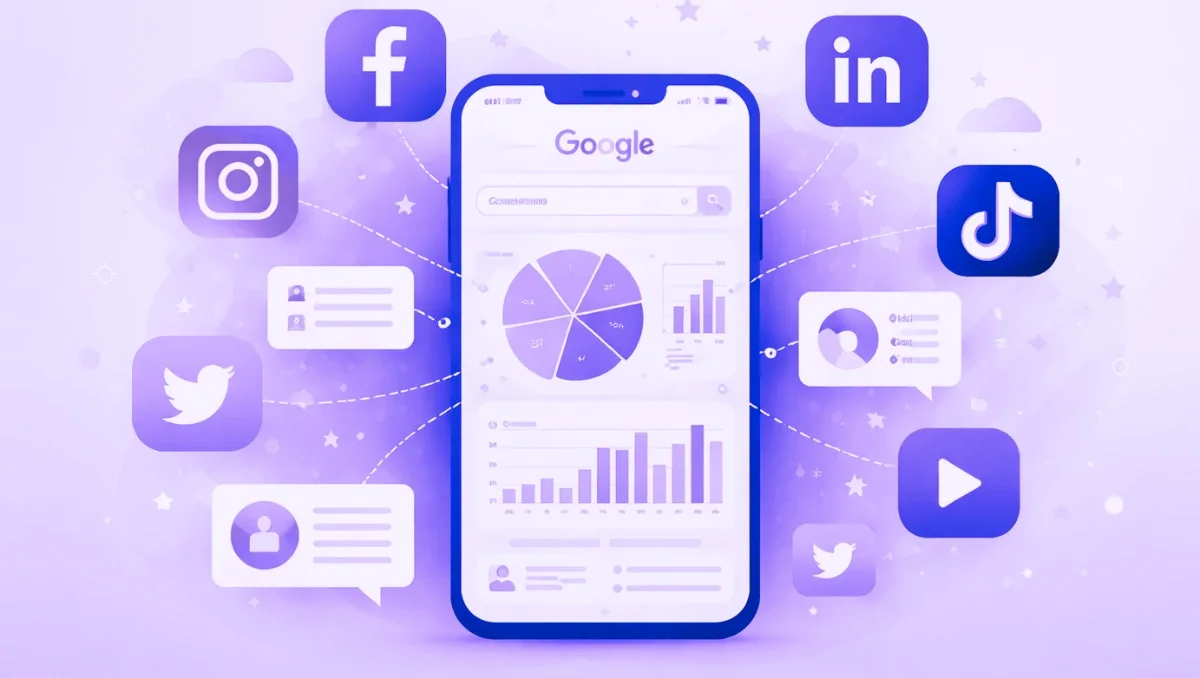
Google’s recent enhancement to Search Console Insights quietly introduced something most businesses are still overlooking — Social Channel Analytics. This update changes how brands should measure visibility, content performance, and conversion paths across search and social platforms.

If your social media content gets engagement but your website traffic or leads don’t reflect that effort, this update explains why — and how to fix it.

What Is Social Channel Analytics in Search Console Insights?

Social Channel Analytics is Google’s way of showing how content discovery now happens across platforms, not just traditional search.

Instead of viewing SEO and social media as separate channels, Search Console Insights now connects:

  • Search performance
  • Content engagement
  • Traffic influenced by social discovery

This confirms what modern algorithms already do: evaluate your brand holistically, not channel by channel.

For businesses, this means visibility is no longer just about ranking — it’s about how content travels, influences, and converts.

Why Google Added Social Signals to Search Console

Google’s AI systems are built to understand:

  • User behavior patterns
  • Brand consistency
  • Content usefulness across platforms

When your content performs well on social media but fails to deliver value on-site, it creates a trust gap — and Google can now detect it more clearly.

This update aligns with how AI-driven ranking systems assess:

  • Brand authority
  • Engagement depth
  • Content relevance beyond clicks

Businesses relying on disconnected strategies are already seeing performance gaps — especially those without aligned SEO and social media services.

What This Update Reveals About Your Brand (That You Didn’t See Before)

Social Channel Analytics exposes hidden issues like:

Content That Attracts Attention But Doesn’t Convert

If social posts drive curiosity but users bounce quickly, Google interprets that as weak intent matching.

This is often caused by:

  • Poor landing page experience
  • Inconsistent messaging
  • Slow or unoptimized websites

This is where professional website development services and UX optimization play a critical role in closing the gap between interest and action.

Social Engagement Without Search Authority

High engagement but low organic growth signals brand imbalance.

Without structured SEO foundations — such as proper internal linking, content hierarchy, and technical optimization — social visibility won’t translate into sustainable rankings.

Brands that combine social strategies with expert SEO services consistently outperform those treating channels separately.

How Social Channel Analytics Impacts Rankings Indirectly

While Google doesn’t rank sites purely on social metrics, AI models use engagement patterns as context signals.

When social traffic:

  • Spends time on your site
  • Explores multiple pages
  • Completes actions

Google’s systems interpret this as relevance and trust — strengthening long-term visibility.

That’s why brands working with a full-funnel digital marketing agency in Dubai gain faster momentum than those focusing on isolated tactics.

The New Measurement Standard: Brand Ecosystem Performance

With this update, Google essentially evaluates:

  • How users discover your brand
  • Where they engage
  • Whether your website fulfills expectations

This reinforces the need for:

A brand that looks strong on social but weak on-site now sends mixed signals — and those signals matter more than ever.

What Businesses Should Do Next (Actionable Steps)

Align Social Content With Website Intent

Every social post should connect to a page built to convert, not just inform.

This is why businesses investing in custom website development see higher ROI from social traffic.

Track Behavior, Not Just Clicks

Clicks alone don’t matter anymore — behavior does.

High-performing brands optimize:

  • Page load speed
  • Content clarity
  • Call-to-action placement

These improvements often fall under proactive website maintenance and optimization strategies.

Why This Update Matters for Dubai Businesses

In competitive markets like Dubai, visibility alone isn’t enough.

You’re competing with:

  • High ad spenders
  • Established brands
  • AI-optimized platforms

To stand out, your business needs:

  • Strong search foundations
  • Credible social presence
  • Conversion-ready websites

That’s exactly why businesses partner with SquareZix — to build performance ecosystems, not just campaigns.

Final Thought

Social Channel Analytics isn’t just a reporting update.

It’s Google signaling that:

  • Discovery happens everywhere
  • Trust is measured holistically
  • Brands must think beyond traffic

If your analytics feel disconnected, your strategy probably is too.

Looking to align SEO, social media, and website performance under one growth strategy?
Explore how SquareZix helps brands turn visibility into measurable business results.

The Orphan Page Trap Created by Website Redesigns (And How to Prevent It)

Website redesigns sound exciting—fresh layouts, cleaner UI, faster performance.
But behind the scenes, a silent SEO disaster often emerges:

👉 Orphan pages.

If your traffic suddenly drops after a redesign…
If Google stops indexing certain URLs…
If your internal links shrink without you noticing…

You may already be caught in the orphan page trap.

In this article, you’ll learn what creates orphan pages during redesigns, how they silently sabotage your SEO, and how to prevent them using the right architecture, linking structure, and ongoing maintenance.

Let’s break it down clearly and practically.

What Is an Orphan Page?

An orphan page is a page on your website that exists—but has no internal links pointing to it.

Google can’t find it.
Users can’t reach it.
Your rankings disappear.

This typically happens during redesigns, migrations, theme changes, and CMS updates.

Why Website Redesigns Create Orphan Pages (Even If Done by “Pros”)

Most redesign agencies focus on visuals—not SEO structure.
Here are the most common redesign mistakes leading to orphan pages:

1. Navigation Is Updated but Pages Are Left Out

Removing menu items without checking page relevance causes entire sections to vanish.

2. URL Changes Without Proper Mapping

If URLs change but old pages aren’t redirected or linked, they become isolated instantly.

3. Designers Replace Important Internal Links

Buttons, banners, and CTAs get redesigned… but old links are never restored.

4. Large CMS Overhauls Break Linking

Switching to new page builders, themes, or CMS structures often removes contextual linking.

5. New Page Templates Don’t Include Content Blocks That Used to Link Internally

Internal linking widgets, “related posts,” or “service highlights” may disappear during rebuilds.

If you recently redesigned your website, some of your most important pages might already be orphaned.

How Orphan Pages Hurt Your Traffic, Rankings, and Revenue

1. Google Stops Crawling Them

No internal links = no discovery.
Even if you submit via sitemap, crawl priority drops sharply.

2. They Lose All Ranking Power

Orphan pages receive zero link equity, so they cannot rank competitively.

3. Your SEO Structure Collapses

Cluster pages, service pages, blog hubs—all lose flow if any pillar page goes “orphaned.”

4. They Confuse Google’s Understanding of Your Website

This becomes even more important for AI Overviews, which rely heavily on structured internal linking.

5. They Waste Money Spent on Content & Web Development

You paid for the page.
You published it.
But Google never sees it—so it brings no results.

How to Detect Orphan Pages After a Redesign (In 10 Minutes)

Step 1: Crawl Your New Website

Use tools like Ahrefs, Screaming Frog or Sitebulb.

Step 2: Compare With Old URL Lists

Look for pages with:

  • 0 inbound internal links
  • Not present in navigation
  • Not included in XML sitemap

Step 3: Check Google Search Console

Use:

  • Pages → Crawled — currently not indexed
  • Orphaned pages report (if available)

Step 4: Analyze via Analytics

Pages with 0 views after redesign = likely orphaned.

How to Prevent Orphan Pages During (and After) Redesigns

1. Maintain a Master URL Map

Every redesign should include:

  • Old URLs
  • New URLs
  • Redirect mapping
  • Internal linking plan

This prevents pages from “dropping off.”

2. Use an Intent-Based Navigation Strategy

Instead of removing pages from menus for style, map them to user intent:

  • Awareness pages
  • Consideration pages
  • Service pages
  • Support pages

This keeps important URLs linked.

3. Build a Smart Internal Linking Structure

All your main service pages should link to each other intelligently.

For example, if you want reliable internal linking help, explore Squarezix’s SEO services in Dubai.

4. Perform a Post-Redesign Link Audit

Within 48 hours of going live.

This can be part of your ongoing website maintenance.

5. Add Linking Blocks on Templates

Such as:

  • “Related articles”
  • “Popular services”
  • “Recommended resources”

6. Use XML Sitemaps But Don’t Rely on Them Alone

Internal linking is still the #1 signals Google trusts.

7. Keep Continuous Maintenance

Most orphan pages happen months after redesign when new content isn’t linked properly.
This is where our website maintenance services in Dubai ensure your architecture stays clean, indexable, and SEO-ready.

How Squarezix Helps You Avoid Orphan Page Problems Forever

With a combination of:

  • Technical SEO audits
  • Internal linking strategy
  • Website structure cleanup
  • Ongoing website maintenance
  • UX-driven architecture redesign

We make sure every page on your site passes:
✔ Crawlability
✔ Indexability
✔ Linking signals
✔ AI Overview eligibility

We have a fully dedicated team of Website development experts and SEO experts.

Need help fixing orphan pages or preventing them during redesigns?

Contact SquareZix today for a complete technical SEO + structure audit.

FAQs

1. What is an orphan page in SEO?

An orphan page is a webpage with no internal links pointing to it. Google cannot discover or crawl it naturally, leading to lost rankings.

2. How do orphan pages happen during redesigns?

They happen when URLs change, menus are updated, or internal links are removed without proper mapping.

3. Can orphan pages be indexed?

Yes, but only if directly submitted via XML sitemap—but they still rank poorly due to lack of link signals.

4. How do I prevent orphan pages in the future?

Maintain a URL map, build a strong internal linking structure, and perform regular website maintenance audits.

5. Does Squarezix fix orphan pages?

Yes, through technical SEO, website maintenance, and website architecture restructuring services.

SEO Routing Errors: How One Wrong URL Can Ruin Your Entire Ranking Strategy

Search engines are fast… but they are also extremely literal.
One wrong URL. One misplaced slash. One redirect chain. One inconsistent routing rule—
And your entire SEO performance can collapse overnight.

This is exactly why SEO routing errors are among the most damaging yet most overlooked issues on business websites today. Whether you’re scaling, redesigning, or migrating your pages, even a tiny routing conflict can cost you rankings, traffic, conversions, and months of SEO work.

In this guide, we’ll break down how routing errors happen, how to detect them fast, and how to fix them before they impact your visibility.

To help you further, SquareZix also provides complete SEO services and website maintenance services to prevent these errors before they cost your business real revenue.

What Are SEO Routing Errors?

SEO routing errors happen when search engines are unable to find, properly load, or understand your website’s pages due to misconfigured or inconsistent URL rules.

Examples include:

  • URLs resolving incorrectly (e.g., /services loading /service)
  • Pages loading under multiple URLs (duplicate content)
  • Pages returning 404 due to incorrect routing
  • Removing or renaming URLs without redirects
  • Wrong canonical pointing to wrong URLs
  • Conflicting CMS or server rules

Even a small routing inconsistency can create:
✔ Crawl disruptions
✔ Indexing drop
✔ Duplicate content
✔ Search visibility loss

Why One Wrong URL Can Break Your Whole SEO Strategy

1. Google Might Index the Wrong Page

If multiple URLs load the same content (e.g., /about and /about-us), Google chooses one—
but not always the one you want.

This dilutes:

  • Page authority
  • Keyword relevance
  • Internal link value

Fix: Always use proper canonicalization and avoid duplicate URL paths.

2. Routing Errors Break Internal Linking Structures

If an internal link points to a URL that no longer exists, it becomes a soft 404 or redirect loop.

This confuses search engines and wipes out link equity.

To avoid this, run internal link audits regularly or consider using a long-term solution like ongoing website maintenance.

3. Wrong URLs Create Crawl Waste (Crawl Budget Loss)

Googlebot wastes time crawling:

  • Broken URLs
  • Redirect chains
  • Duplicate paths

Which means your important pages get crawled less often—slowing down rankings and updates.

4. Redirect Chains Slow Down Page Experience

Routing mistakes often create long redirect chains:

/old-page → /older-page → /new-page → /final-page

This causes:

All of which directly impact SEO performance.

5. URL Changes Without Proper Routing Can Wipe Rankings Overnight

If you change URLs without routing them correctly, Google treats them as new pages.

Meaning:

  • You lose all previous rankings
  • Backlinks no longer count
  • Keyword authority resets

This is the #1 reason rankings drop after redesigns or migrations.

This is why smart businesses partner with a website development company that understands SEO deeply.

Common Routing Errors Found on UAE Business Websites

✔ Lowercase vs Uppercase URLs

/Services and /services can be two different pages.

✔ HTTP/HTTPS Conflicts

Google indexing two versions lowers trust.

✔ www vs non-www mismatch

For example:
https://example.com
vs
https://www.example.com

✔ Query parameter duplicates

/products?color=black
/products/?color=black

✔ CMS Autogenerated URLs

Shopify, WordPress, and headless CMS sites often generate:

  • Tag URLs
  • Pagination URLs
  • Archive URLs

These can cannibalize SEO if routing isn’t controlled.

How to Diagnose Routing Errors in 10 Minutes

Here’s a quick routine used by SEO experts and technical teams:

Step 1: Check Google Search Console → Indexing → Pages

Look for:

  • “Duplicate without user-selected canonical”
  • “Alternate page with canonical”
  • “Soft 404”
  • “Redirect error”

Step 2: Crawl the Site Using Screaming Frog or Sitebulb

Identify:

  • Duplicate URLs
  • Redirect chains
  • 404s
  • Canonical mismatches

Step 3: Review Server-Level Routing (Nginx/Apache/Cloudflare)

Businesses often have:

  • Outdated rewrite rules
  • Conflicting cache routes
  • Dev/stage URLs still active

Step 4: Test URL Consistency Manually

Check whether:

  • URLs work without trailing slash
  • URLs work both ways
  • URLs resolve with correct parameters

Step 5: Validate Internal Link Consistency

One wrong routing rule usually spreads like a web across pages.

Perform a quick automated internal link check.

How to Fix SEO Routing Errors (Without Breaking Your Site)

1. Decide ONE canonical URL structure

Examples:

  • Always lowercase
  • Always with trailing slash
  • Always HTTPS
  • Always www or non-www

2. Implement 301 redirects properly

Use:

  • No chains
  • No loops
  • No mixed redirects

3. Clean Up Auto-Generated URLs

If your CMS is generating unnecessary pages, noindex them or block them via robots.txt.

4. Update Internal Links After Any URL Change

This is the step most businesses skip—leading to long-term ranking damage.

Consider contacting professional SEO agency in Dubai to prevent this.

5. Validate Using Google Search Console

After fixing routing rules, run:

  • URL inspection
  • Request reindex
  • Compare old vs new performance

Why Dubai Businesses Must Take Routing Seriously

UAE businesses—especially in competitive niches—cannot afford routing mistakes:

Because Google evaluates:

  • Accuracy
  • Speed
  • Consistency
  • Crawlability

Even more heavily after AI Overviews.

Routing errors break all four.

If you’re scaling or redesigning your site, partnering with a technical SEO-aware development team like SquareZix prevents costly ranking losses.

Final Thoughts:

Great content, backlinks, and On-page optimization won’t matter
if Google can’t route to your pages correctly.

Fix your routing → fix your SEO foundation → boost rankings without extra ads or content.

If you want a complete seo audit services to fix routing, crawl waste, and indexing issues, SquareZix offers:

👉 Full Professional Custom Website Development
👉 Website Maintenance & Performance Optimization

Need help fixing routing issues?

We handle everything from canonical failures to broken internal links.
Just tell us what CMS you use. Contact SquareZix Today!

Google Search Console’s New Annotation Update: What It Means and How to Use It

Google has quietly rolled out one of its most important updates in years — Custom Annotations in Google Search Console.
While the feature looks simple at first glance, it has massive implications for SEO performance tracking, technical optimization, and digital growth for UAE businesses.

For companies trying to strengthen their presence online, especially in competitive regions like Dubai, annotations provide the missing bridge between real website changes and visible ranking movements.

If you’re a brand looking for reliable SEO services in Dubai, this update can finally give you the clarity you’ve been missing — and it’s a feature we at SquareZix have already integrated into our SEO workflow.

What Exactly Is the New GSC Annotation Feature?

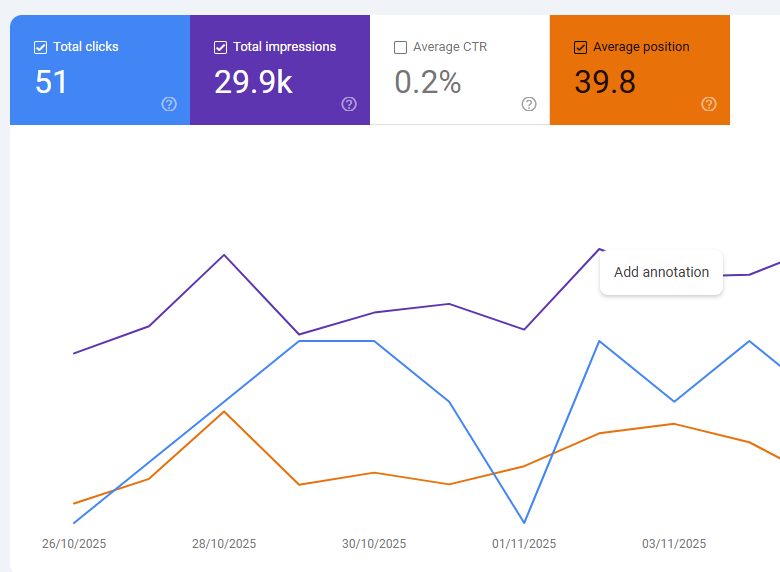
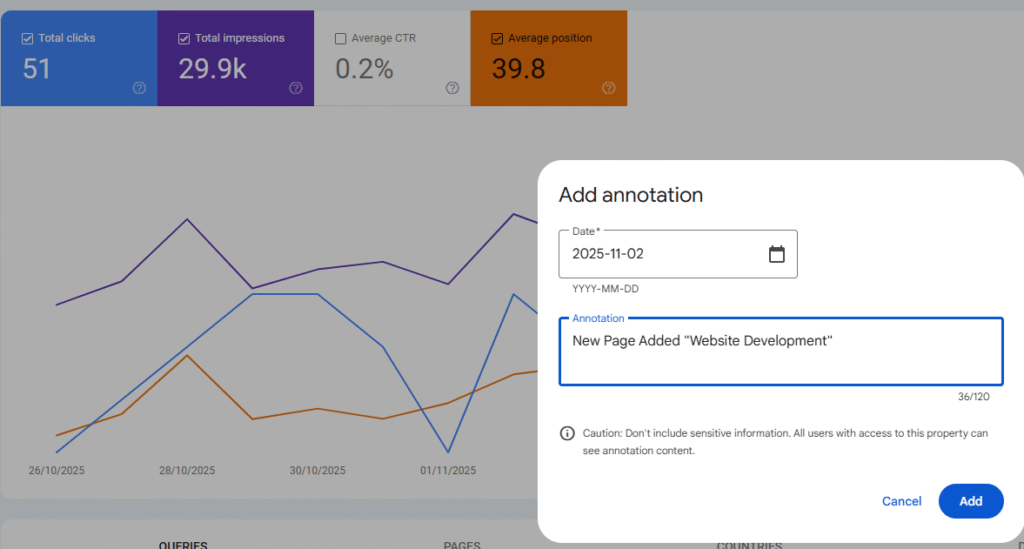
Google Search Console now lets you add custom notes directly on your Performance charts.

Here’s what you can do with it:

  • Add a note on any date inside Performance reports
  • Record changes like:
    • Website redesigns
    • Content updates
    • Core Web Vitals improvements
    • Google algorithm updates
    • SEO fixes
    • New landing page launches
    • Server or hosting changes
  • View them on the graph as timeline markers
  • Share them instantly with your team (annotations are visible to everyone with access)

Technical limits you should know:

  • You can add up to 200 annotations per property
  • Old annotations get deleted after 500 days
  • Each annotation can be up to 120 characters

Why This Update Is a Big Deal for Your SEO Strategy

Most SEO fluctuations are not random.
But until now, there was no easy way to correlate traffic drops or ranking spikes with real-world events.

Annotations solve this.

1. You Finally Understand “Why” Rankings Change

Traffic dropped suddenly?
Instead of guessing, annotations help you trace the exact reason:

  • Did Google release a Broad Core Update?
  • Did you publish a new blog?
  • Did your developer change internal links?
  • Did your hosting slow down?

One single note inside the graph now explains everything.

2. Better Attribution for SEO Work

Customers often ask:

“What specifically caused this improvement?”

With annotations, you can point directly to SEO activities like:

At SquareZix, we annotate every change for clients — making the value of SEO transparent and measurable.

How Squarezix Uses Annotations to Improve Your SEO ROI

This is where we get ahead of your competitors.

1. Logging Every Major SEO Action

Whenever we:

  • Fix indexing issues
  • Improve schema markup
  • Deploy new content
  • Optimize metadata
  • Update your site structure
  • Improve your UX flow

…we log it instantly using annotations.

This creates a performance timeline that connects our work to your traffic growth.

2. Annotating Algorithm Updates in Real-Time

SquareZix tracks Google algorithm updates aggressively.
Whenever Google rolls out:

…we add annotation markers so you can see exactly how your site reacts.

3. Diagnosing Problems Faster

When something goes wrong — like a sudden drop in impressions — annotations help us trace the cause within minutes.
Combined with our technical SEO service and ongoing website maintenance, it ensures issues never stretch for weeks.

How UAE Businesses Can Use Annotations to Improve SEO

1. Record All Website Changes

If your developer uploads new code, adds plugins, or edits the theme — annotate it.

2. Note All Content Activity

  • Blog uploads
  • Landing page updates
  • Metadata improvements
  • E-commerce product page improvements

This works especially well for companies with ongoing content plans.

3. Use It With Your Marketing Campaigns

Marketing and SEO rarely align perfectly… unless you annotate:

If you’re running paid ads, link annotations to performance changes.

Why This Matters Even More in the AI SEO Era

With Google’s AI Overviews becoming part of search behavior, SEO is now driven by:

  • Content quality
  • Entity signals
  • Website depth
  • Clear technical structure
  • Speed
  • Trust signals

Annotations make this entire AI-led ecosystem trackable.

We use them to:

  • Notify when AI-focused content is published
  • Track pages optimized for AI visibility
  • Log technical improvements needed for AI SEO
  • Measure the impact of AI-ready schema and structured data

If you want to stay ahead in AI search, check out our AI SEO services in Dubai.

When Should You Absolutely Add an Annotation?

Every time you:

✔ Update titles, meta tags, or structured data
✔ Add new blogs or landing pages
✔ Improve internal linking
✔ Switch themes or templates
✔ Change hosting
✔ Improve site speed
✔ Fix crawl or index issues

Why Squarezix Clients Get Better SEO Results After This Update

Because we:

  • Track everything you change
  • Attribute every improvement to a specific action
  • Diagnose problems in a fraction of the time
  • Provide transparent reports
  • Map all ranking wins to the exact cause

In a market as competitive as Dubai, clarity equals growth — and this update gives you both.

If you want performance-driven SEO where every improvement is tracked, explained, and maximized, Squarezix is the partner you need.

Final Thoughts

The new Google Search Console Annotations feature may look simple, but it’s a game-changer for modern SEO and performance reporting.

For UAE businesses and especially Dubai-based companies aiming for stable organic growth, this update helps you understand why your rankings move — and how to move them faster.

If you want SquareZix, the leading SEO agency in Dubai to maintain your site, optimize your SEO, and use annotations to track every growth opportunity, we’re here to help.

Is Google Even Crawling Your Website? How to Diagnose Crawl Issues in 10 Minutes

If your website isn’t showing up on Google the way it should, there’s a good chance the issue isn’t your content, keywords, or backlinks — it’s your crawlability.

Google can’t rank what it can’t crawl.
And the wild part? Most businesses never check this.

The good news: you can diagnose 80% of crawl problems in just 10 minutes, even if you’re not a technical SEO expert.

Let’s unpack this in a simple, business-friendly way — and make sure Google is actually seeing your website.

Why Crawl Issues Matter More Than You Think

Crawl issues silently block your website from ranking even if:

  • You publish high-quality content
  • You hire SEO agencies
  • You run ads
  • You invest in design and development

If Google can’t crawl your pages, your growth will always be stuck.
At SquarezZix, we fix these issues through technical SEO audits and ongoing website maintenance, but here’s how you can quickly spot the problem.

Diagnose Crawl Issues in 10 Minutes (Beginner-Friendly)

1. Check If Your Website Is Indexed (30 seconds)

Open Google and type:

site:yourwebsite.com

✔ Google isn’t crawling regularly
✔ There may be technical blocks
✔ Your sitemap isn’t working
✔ Your website structure is weak

If this already looks bad, you likely need technical fixes — something we handle through our SEO Services in Dubai at SquareZix.

2. Check Google Search Console for Crawl Errors (2 minutes)

Inside Search Console, go to:

Indexing → Pages

Look for:

  • “Not Found (404)”
  • “Crawled — currently not indexed”
  • “Blocked by robots.txt”
  • “Discovered — currently not indexed”
  • “Duplicate, Google chose different canonical”

Each one tells you exactly why Google isn’t crawling your pages.

If you don’t have Search Console installed (many don’t), you need it ASAP.
This is part of our website maintenance services, where we fix indexing and crawl issues before they become expensive problems.

3. Test Your Robots.txt File (1 minute)

Go to:

yourwebsite.com/robots.txt

If you see something like:

Disallow: /

Google is completely blocked from crawling your website.

Even small mistakes here can kill your rankings instantly.
We see this a lot on newly developed or migrated websites — which is why proper reviews through Web Development Services are essential.

4. Run a Live URL Test in Search Console (2 minutes)

Use “URL Inspection” to test any page.

This will show:

  • When Google last crawled it
  • Whether the URL is indexable
  • If resources (images/scripts) are blocked
  • Whether your canonical is correct

If Google hasn’t crawled your page in weeks or months, something is wrong.

Common reasons:

  • Slow hosting
  • Broken internal links
  • Low-quality or thin pages
  • No XML sitemap
  • Too many technical errors

These are issues SquareZix fixes through full technical SEO optimization.

5. Check Website Speed (1 minute) — Because Slow = Not Crawled

Use PageSpeed Insights.

When your website loads slowly:

  • Google reduces your crawl budget
  • Googlebot stops crawling halfway
  • Important pages get skipped
  • Rankings drop

Slow websites also push users away — a lose-lose situation.
This is why a good website maintenance and speed optimization plan makes a huge difference.

6. Analyze Internal Linking (2 minutes)

Google uses internal links to discover pages.

If your important pages are buried deep or hard to reach, Google simply won’t crawl them.

Check:

  • Does your homepage link to the main money pages?
  • Does your blog link to relevant service pages?
  • Do orphan pages exist?

At SquareZix, we clean all of this in our SEO and development workflows to ensure Google can crawl and rank every important page.

Why Crawl Problems Happen (Simple Explanation)

Most crawl issues come from:

  • Poor website structure
  • Slow servers
  • Incorrect robots rules
  • No sitemap
  • Broken redirects
  • Thin or duplicate content
  • JavaScript-heavy pages

A modern website needs more than just “SEO keywords” — it needs technical care, ongoing updates, and a strong backend.

Want Google to Crawl and Rank Your Website Faster?

Crawlability is one of the foundation pillars of SEO — fixing it early can unlock huge improvements in:

✓ Rankings
✓ Organic traffic
✓ Leads
✓ Sales
✓ Brand visibility

If you want Google to notice your website again, Squarezix can help with:

  • Technical SEO audits
  • Monthly website maintenance services
  • Performance optimization
  • Full website restructuring
  • SEO-ready web development

You can explore all services on our site or reach out for a quick audit.

FAQs: Diagnosing Crawl Issues

1. How do I know if Google has stopped crawling my website?

Check your “Last Crawl” date inside Google Search Console’s URL Inspection tool. If it hasn’t been crawled in weeks, you have crawl issues.

2. Why is Google crawling but not indexing my pages?

This happens due to:

  • Thin content
  • Slow loading pages
  • Duplicate content
  • Blocked resources
  • Weak internal links

A technical audit usually reveals the cause.

3. Can crawl issues affect rankings even if my content is good?

Absolutely. If Google can’t reach or render your page properly, it won’t rank — regardless of how good the content is.

4. How often should I check crawl errors?

At least once a month — or weekly if your website is large.
SquareZix handles this as part of its website maintenance plans.

5. Who should fix crawl issues — my developer or SEO agency?

Most crawl issues require both.
That’s why SquareZix integrates SEO + development under one roof for faster fixes.

How AI Sees Your Website: Ranking in the Era of Machine Judgement

In today’s search landscape, your website isn’t just being evaluated by humans—it’s being judged by machines. Google’s algorithms, AI-driven ranking systems, and even conversational models like SGE (Search Generative Experience) interpret your site the way a human might read, feel, and trust your content.

If you’ve been focusing only on keywords and backlinks, you might be missing what really matters now: how AI perceives your brand online.

Let’s explore how AI sees your website, and what you can do to make sure it passes the new era of machine judgement.

1. AI Doesn’t Just Read—It Understands Context

Traditional SEO rewarded keywords and link-building. But AI search systems (like Google’s MUM and Gemini) now analyze meaning, tone, and relevance instead of isolated keywords.

If your content sounds robotic or over-optimized, AI models may actually downgrade it for lack of authenticity.

To improve AI perception:

  • Use natural, conversational language—just like you’d speak to a customer.
  • Focus on semantic SEO—write for topics, not just keywords.
  • Include related terms and subtopics to show content depth.

2. Site Performance is Machine-Visible

You may not notice a slight delay in your website loading time—but AI does.
Search engines now measure Core Web Vitals, which analyze your site’s:

  • Loading speed (LCP)
  • Interactivity (FID)
  • Visual stability (CLS)

If your pages take too long to load or jump around while loading, AI ranks you lower.

That’s why investing in a fast, technically sound website through a trusted partner like the SquareZix, the Best Website Development Company in Dubai is crucial.

3. Design and UX: The Emotional Intelligence of Machines

AI evaluates user experience (UX) just like humans do—but at scale.
If visitors bounce off your site in seconds, the algorithm assumes it’s irrelevant or confusing.

This is where UX psychology meets AI ranking logic.

  • Clean design = clarity for both humans and machines.
  • Strategic white space = cognitive ease.
  • Smart CTAs = improved engagement signals.

For ongoing optimization, you can explore our website maintenance services to ensure your site stays AI and user-friendly.

4. Content Quality: The E-E-A-T Factor

AI models like Gemini, GPT, and BERT heavily prioritize Google’s E-E-A-T principles:

  • Experience
  • Expertise
  • Authoritativeness
  • Trustworthiness

Your website must show real credibility — not just claim it.
That means:

  • Using author bios and verified credentials.
  • Featuring case studies or client success metrics.
  • Including schema markup so AI systems can extract structured data.

5. Visuals and Accessibility: What AI ‘Sees’ Beyond Text

AI doesn’t just read — it looks.
Computer vision models now interpret your site’s images, videos, and layout structure.

Alt texts, file names, and even visual hierarchy tell AI what your brand represents.
For example:

  • Poorly named images (like “IMG1234.png”) hurt your understanding score.
  • Descriptive visuals with proper meta data improve AI comprehension.

Adding structured, optimized visuals is now as important as good copy.

6. AI Detects Authenticity and Engagement

The era of content mills is over.
AI can now detect emotion, tone, and engagement patterns within text.

Websites that feel genuinely human — with unique tone, emotional storytelling, and consistent engagement (through comments or social signals) — are prioritized.

That’s why it’s crucial to integrate social media marketing into your SEO efforts. Align your site’s tone with your social content to help AI identify a consistent brand personality.

7. Structured Data: Speaking AI’s Language

Want AI to understand your website faster? Speak its language: structured data.

Adding schema markup (for articles, products, FAQs, and reviews) helps AI categorize and display your content in rich results and AI overviews.

Think of structured data as a “cheat sheet” that helps machines interpret your content correctly.
It’s a must-have for businesses targeting the top of AI-generated summaries.

8. Future-Proofing Your Website for Machine Judgement

AI’s perception of your site will only get sharper.
To stay ahead:

  • Prioritize content clarity and semantic richness.
  • Maintain high site speed and mobile responsiveness.
  • Keep content fresh, accurate, and value-driven.

Remember: in this new search landscape, you’re no longer writing for people or algorithms—you’re writing for both.

By aligning your strategy with AI perception, you not only improve visibility but also build lasting digital trust.

Make AI Work for You, Not Against You

If your website isn’t ranking or converting as it should, it might not be your content — it’s how AI interprets it.
That’s where Squarezix steps in.

As the leading Website Development Agency in Dubai, we combine AI SEO Services, UX strategy, and technical optimization to make your website both human- and machine-approved.

Get a Free SEO Consultation and discover how your site performs under AI’s lens.

FAQs

1. What does “AI judging my website” mean?
AI judgement refers to how machine learning systems evaluate your website for relevance, credibility, and user experience before deciding its ranking position.

Q2. How can I improve how AI sees my website?
Focus on structured data, semantic content, page speed, and trustworthy backlinks. Partnering with an experienced SEO company in Dubai like Squarezix can accelerate results.

Q3. Does design affect how AI ranks my website?
Yes. AI models measure bounce rate, engagement, and layout stability. A well-designed site sends positive behavioral signals that boost ranking. Contact us for website design services in Dubai!

Q4. Is AI-based SEO different from traditional SEO?
Absolutely. Traditional SEO focused on keywords and links, while AI-based SEO focuses on meaning, experience, and user satisfaction metrics.

Q5. How often should I update my website for AI algorithms?
At least quarterly. Regular updates signal freshness and keep your structured data aligned with evolving AI search models.

Conclusion

AI isn’t replacing SEO—it’s redefining it.
Your website now needs to communicate clearly with machines while staying emotionally engaging for humans.

At Squarezix, we help you build that bridge — blending design, SEO, and branding strategies that make both AI and audiences love your website.

Contact for AI SEO services in Dubai!

How to Rank Your Ecommerce Store on Google Shopping in Dubai

If you run an online store in Dubai, you already know how competitive the ecommerce landscape is. Dozens of brands are fighting for the same audience, and the real challenge isn’t just creating a store — it’s getting it seen. That’s where Google Shopping comes in.

Google Shopping helps your products appear directly in front of customers who are ready to buy — complete with images, pricing, and reviews. But ranking high there isn’t automatic. You need a smart mix of optimization, feed accuracy, and website readiness.

Let’s break down exactly how you can get your ecommerce store ranking higher on Google Shopping in Dubai — and turn clicks into conversions.

1. Start with a Perfect Product Feed

Think of your product feed as your store’s resume — it tells Google what you sell, how much it costs, and why it should appear for specific searches.

A strong feed includes:

  • Clear and keyword-optimized product titles (e.g., “Bluetooth Speakers with Mic – Portable & Rechargeable”)
  • Detailed product descriptions
  • High-quality images
  • Accurate prices and availability
  • Unique product identifiers like GTIN or MPN

Make sure there are no errors or missing fields in your Merchant Center. Even one missing field can cause your product to be disapproved or perform poorly.

If your ecommerce platform doesn’t sync properly with Google Merchant Center, a team like the Best Website Development Company in Dubai can help you automate and structure your product feed efficiently.

2. Optimize Product Titles Like SEO Headlines

Your product title is your biggest ranking signal in Google Shopping.

Instead of writing vague titles like “Running Shoes”, use a descriptive structure such as:
👉 Brand + Product Type + Feature + Color/Size
Example: “Nike Air Zoom Pegasus Men’s Running Shoes – Size 44, Blue”

These titles help both Google and shoppers understand what you’re selling instantly. The right mix of clarity and keywords improves your click-through rate significantly.

3. Leverage Product Images Strategically

Visuals sell — especially in ecommerce. A single image determines whether a user clicks or scrolls past.

Use crisp, high-resolution images on a clean white background, following Google’s guidelines. Avoid overlays, watermarks, or promotional text.

However, for lifestyle products like jewelry or fashion, include one additional image that shows the product in context — this improves engagement and conversions.

4. Price Competitively and Use Promotions Smartly

Google Shopping heavily favors listings with competitive pricing.

If your prices are significantly higher than competitors, even perfect SEO won’t keep you on top. Analyze similar listings using the “Benchmark Price” data in your Merchant Center and adjust accordingly.

You can also use Merchant Promotions to highlight limited-time discounts or bundle offers. These small visual badges often boost clicks by 20% or more.

5. Improve Landing Page Experience

Even if your product ranks, a poor landing page kills conversions. Google’s algorithm evaluates how users interact with your page — bounce rate, loading speed, and mobile experience all matter.

Your product page should include:

  • Fast loading time (under 2 seconds)
  • Mobile-first design
  • Clear CTA like “Buy Now” or “Add to Cart”
  • Transparent delivery and return information
  • Product reviews and trust badges

To maintain this consistently, consider ongoing website maintenance services. Regular monitoring ensures your site remains technically sound and performs optimally — especially when adding new products.

6. Don’t Forget Product Reviews and Ratings

Customer reviews improve credibility and click-through rates. Google uses structured data (schema markup) to display these star ratings on your ads and listings.

Use verified review integrations or platforms like Trustpilot, Yotpo, or Loox to collect authentic feedback. The more positive reviews your products have, the more visibility they’ll gain in Google Shopping results.

7. Combine SEO + Paid Strategies for Maximum Results

Ranking in Google Shopping isn’t only about free listings — combining organic and paid strategies delivers the best ROI.

By syncing your Google Shopping campaign with your SEO services in Dubai strategy, you ensure consistency in keywords, product targeting, and visibility.

Your organic listings improve click trust, while paid ads ensure your top products appear during competitive seasons — a powerful one-two punch.

8. Why Most Ecommerce Stores Fail to Rank

Many ecommerce brands in Dubai overlook three critical elements:

  1. Feed hygiene – outdated or inconsistent product data
  2. Weak website speed – slow pages lead to high drop-offs
  3. Lack of mobile optimization – most shoppers browse on phones

Partnering with an expert ecommerce SEO agency can help you address these gaps and ensure both Google and your customers love your store.

9. Keep Your Store Updated & Secure

The ecommerce environment changes fast — algorithm updates, new features, and user expectations evolve monthly.

That’s why ongoing technical updates, plugin maintenance, and security audits are essential. Neglecting them can lead to product feed errors, broken links, or checkout issues.

FAQs

1. How long does it take to rank on Google Shopping in Dubai?
Usually, it takes 2–4 weeks for your listings to stabilize after proper optimization, but achieving top positions depends on feed quality, pricing, and competition.

2. Can I appear on Google Shopping without paying for ads?
Yes, you can show up in free listings if your feed meets Google’s requirements. However, paid ads services increase visibility faster and reach more shoppers.

3. Do I need SEO for Google Shopping?
Absolutely. Even though Shopping focuses on feeds, product titles, descriptions, and landing page SEO heavily influence rankings.

4. How do I fix disapproved products in Google Merchant Center?
Check for missing GTINs, policy violations, or incorrect attributes. Fix them and re-sync your feed to restore visibility.

5. Should I use Shopify or WooCommerce for my Google Shopping store?
Both work well, but Shopify websites simplifies integration. If you’re scaling fast, consult the Best Website Development Company in Dubai for a platform setup whether wordpress websites or headless cms websites tailored to your growth goals.

Final Thoughts

Ranking your ecommerce store on Google Shopping in Dubai is about precision — not luck. From feed optimization to UX design and review management, every element contributes to your visibility and conversion rate.

At SquareZix, we specialize in helping businesses like yours integrate smart SEO strategies, optimized feeds, and technical support that drive sales.

Your customers are searching — it’s time they find you first. Contact us Today!

How Query Groups Help You Discover High-Intent Search Traffic You’ve Been Ignoring

For businesses in Dubai and beyond, attracting traffic is just the first step. The real challenge is converting that traffic into leads and sales. Even websites with high visitor numbers often fail to reach their revenue potential. Google’s latest update in Search Console: Query Groups offers a game-changing solution to uncover high-intent search traffic you may have been overlooking.

In this article, we’ll explore how Query Groups work, why they matter for SEO, and how you can leverage them to capture valuable traffic that converts.

Looking to capitalize on high-intent traffic? Squarezix offers professional SEO services in Dubai to turn insights into revenue.

What Are Query Groups?

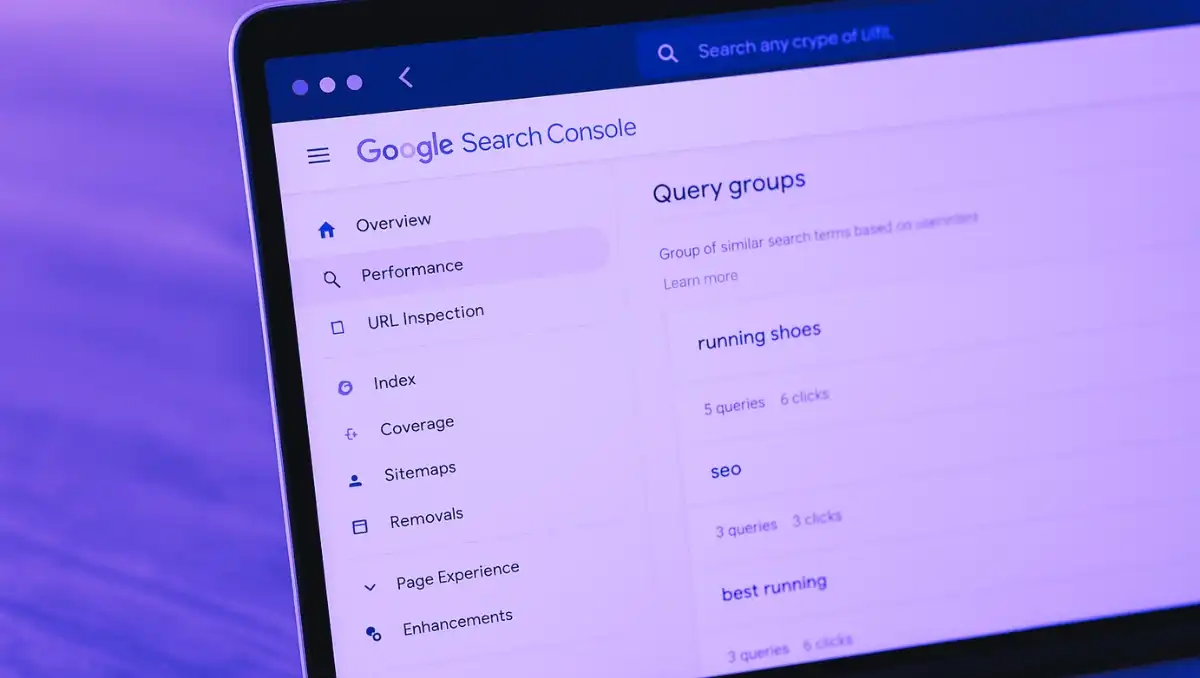
Query Groups is a feature in Google Search Console that automatically clusters similar search queries under a single group. Rather than analyzing dozens of slight variations of the same keyword, Query Groups organize queries based on user intent.

For example, searches like:

  • “Best running shoes Dubai”
  • “Where to buy running shoes in UAE”
  • “Affordable sneakers online Dubai”

…may all appear under one query group. This allows you to see the aggregate clicks, impressions, and trends for a group rather than individual keywords, giving a clearer picture of what users really want.

Query Groups in Google Search Console

Why Query Groups Are Vital for Discovering High-Intent Traffic

  1. Identify Hidden Opportunities
    Traditional keyword reports might miss low-volume but high-conversion search terms. Query Groups reveal clusters of searches with strong intent, enabling you to focus on traffic that’s likely to convert.
  2. Understand User Intent
    Instead of targeting keywords blindly, you can now see what users are actually looking for. This helps you create content that aligns with their goals, improving your chances of conversion.
  3. Optimize Content Strategy
    Query Groups highlight gaps in your content. For example, if one cluster is driving impressions but not clicks, it indicates a need for better headlines, meta descriptions, or landing page optimization.
  4. Prioritize Campaigns
    Not all traffic is equal. By focusing on query groups with high commercial intent, businesses can allocate budget and effort efficiently, boosting ROI.

How to Leverage Query Groups for SEO

1. Analyze High-Click Groups

Identify the query groups that bring the most clicks. Then, ensure your landing pages match the intent of these groups.

2. Create Targeted Content

Once you understand the intent behind a query group, create blog posts, guides, or product pages that answer those queries comprehensively.

For example, if a query group centers on “eco-friendly jewelry Dubai,” you could write a detailed guide highlighting your sustainable products.

3. Optimize for Conversions

High-intent traffic isn’t valuable if it doesn’t convert. Use clear CTAs, lead capture forms, and fast-loading pages to maximize conversions.

Squarezix combines Web Development Services with SEO insights to ensure your website converts traffic into leads effectively.

4. Monitor Trends Over Time

Query Groups also show trending queries within a group. Monitoring these trends helps you update content, adjust PPC campaigns, and stay ahead of competitors.

Benefits for Dubai Businesses

  • Local SEO Enhancement: Focus on Dubai-specific queries and trends.
  • Better ROI on SEO: High-intent clusters improve conversion rates.
  • Content Efficiency: Avoid creating multiple pages for near-identical queries.
  • Insights for Paid Campaigns: Use query group data to inform PPC strategy with Google Ads.

FAQs

1. What is high-intent search traffic?
High-intent traffic consists of users actively looking to purchase, sign up, or take action. These visitors are more likely to convert than casual browsers.

2. How do query groups differ from traditional keyword reports?
Query groups cluster similar searches by user intent, whereas keyword reports show individual search terms, often missing the bigger picture.

3. Can query groups impact my website ranking?
Query groups themselves don’t change rankings but provide insights to optimize content, which can indirectly improve SEO performance.

4. How often should I check query groups?
Review query groups monthly to identify new high-intent clusters and track performance trends over time.

5. Can Squarezix help implement insights from query groups?
Yes. Squarezix offers SEO services in Dubai that integrate query group insights into your website strategy, ensuring content and campaigns target the right audience.

Final Thoughts

Query Groups are a powerful tool for discovering high-intent traffic you may have been ignoring. By analyzing user intent, optimizing content, and prioritizing high-conversion queries, Dubai businesses can significantly boost leads and revenue.

Ready to capture high-intent traffic? Contact Squarezix, the leading SEO company in Dubai today and start converting visitors into customers.

5 SEO Shortcuts That Do More Harm Than Good

When business owners want to see quick results from SEO, it’s tempting to take a few “shortcuts.” Maybe a consultant promised a fast climb to page one, or an AI tool suggested a trick to “beat the algorithm.” Unfortunately, most SEO shortcuts don’t just fail — they can actually damage your website’s visibility, credibility, and long-term growth.

At Squarezix, we’ve seen how these shortcuts cost businesses months of lost rankings and sales. In this blog, we’ll explore five common SEO shortcuts that do more harm than good — and what to do instead to build lasting results.

1. Stuffing Keywords Instead of Building Relevance

One of the oldest tricks in the SEO book is keyword stuffing — cramming your target words into every line of your content. Years ago, this might have worked. Today, Google’s algorithms understand context, not repetition. Over-optimized pages read poorly, turn visitors away, and often get flagged for spam.

Modern SEO is about topic relevance, search intent, and content value — not how many times you can repeat a keyword. Instead of repeating “best plumber in Dubai” 20 times, focus on answering what users actually search for — pricing, reviews, turnaround time, and reliability.

At Squarezix’s SEO Services, we use semantic SEO and content clustering to help websites rank naturally for a wide range of keywords without triggering spam filters.

2. Buying Backlinks Instead of Earning Authority

Link building is critical, but shortcuts like buying backlinks or joining link farms are dangerous. Google’s Penguin algorithm and SpamBrain system can easily detect paid or irrelevant links. Once flagged, your site could lose ranking authority or even get manual penalties.

Real link authority comes from valuable content that others want to reference. Guest posting on reputable sites, sharing industry insights, or creating original research is how you build credibility the right way.

If your business operates in Dubai or the GCC, partnering with an SEO company in Dubai like Squarezix ensures your link-building strategy is ethical, localized, and Google-compliant — building trust instead of risking penalties.

3. Ignoring Technical SEO Because “It’s Too Complicated”

Some businesses treat technical SEO like background noise — until their pages suddenly stop appearing in search results. Ignoring elements like crawlability, site structure, or page load time is one of the biggest seo shortcuts that silently kills performance.

A single broken redirect chain, missing XML sitemap, or duplicate tag can confuse search engines. Even something as simple as large image files or poor Core Web Vitals can harm your rankings.

Instead of avoiding it, invest in technical maintenance. At Squarezix, we don’t just optimize your content — we perform full website audits and continuous website maintenance services to ensure your SEO efforts are technically sound and future-proof.

4. Using AI Content Without Strategy or Human Review

AI writing tools are everywhere now, and yes — they can save time. But using them as a shortcut for bulk SEO content is a major mistake. Google’s algorithms now assess experience, expertise, authoritativeness, and trustworthiness (E-E-A-T) — and generic AI content often fails those standards.

Poorly written AI content lacks depth, originality, and emotional tone. It can even lead to duplicate phrasing across multiple websites using the same prompts.

The solution? Use AI strategically — for research, outlines, and ideas — but always refine content with human expertise. At Squarezix, we blend AI precision with human storytelling to create SEO content that’s both optimized and genuinely engaging.

5. Skipping Regular Updates and Maintenance

You’ve done the SEO setup, written your blogs, optimized your titles — and now your website runs on autopilot, right? Unfortunately, that’s another shortcut that harms long-term rankings.

SEO isn’t a one-time fix. Algorithms evolve, competitors publish new content, and user behavior shifts constantly. Without updates, your website slowly loses authority and ranking positions.

Regular content refreshes, security checks, and performance audits are what keep your site competitive. Businesses that invest in website development services and ongoing optimization consistently outperform those that treat SEO as a one-off project.

That’s why professional website maintenance services in Dubai often include continuous SEO monitoring — because protecting your site means preserving your online growth.

The Smarter Alternative: Sustainable SEO Wins

The truth is, SEO shortcuts may give you a temporary boost, but they don’t build a sustainable digital presence. Google is smarter, users are savvier, and the cost of recovering from penalties can be higher than doing it right the first time.

The smarter path is to build a strong, long-term SEO foundation — one that combines technical health, meaningful content, and ethical growth tactics.

If your website traffic has plateaued or rankings keep dropping despite your efforts, it’s time to switch from “quick wins” to consistent performance. Squarezix helps businesses create scalable SEO strategies designed for visibility, credibility, and conversion.

Frequently Asked Questions (FAQs)

1. Are SEO shortcuts really that risky?

Yes. SEO shortcuts like buying backlinks, keyword stuffing, or using auto-generated content can cause Google penalties, ranking drops, or even deindexing. Sustainable SEO focuses on quality, consistency, and long-term trust signals.

2. What are the most common SEO shortcuts businesses use?

Common shortcuts include duplicate content, AI-only blogs, hidden text, poor link practices, and ignoring technical SEO. These seem harmless but often backfire as Google’s algorithms evolve.

3. How can I tell if my SEO agency is using shortcuts?

If your agency promises “page 1 results in 7 days,” uses spammy backlinks, or avoids transparency in reporting, that’s a red flag. Ethical agencies like Squarezix provide data-driven updates and long-term strategies.

4. Can AI content still be used for SEO?

Yes — but only when guided by human expertise. Use AI for idea generation or outlines, then refine and add expertise manually to meet Google’s E-E-A-T standards.

5. How do I build SEO success without shortcuts?

Focus on optimized site structure, user-focused content, mobile speed, local SEO, and authority backlinks. Consistent updates and professional SEO services will yield better, safer growth than any shortcut.

Final Thoughts

Shortcuts might seem appealing when you want results fast, but in the world of SEO, patience and precision always win. The more you invest in ethical SEO practices, the more stable and profitable your digital presence becomes.

Whether you’re struggling with low visibility or need a complete SEO overhaul, Squarezix can help you rise above short-term tricks and achieve lasting impact.

Discover how our SEO services in Dubai can help your brand grow sustainably — not just rank higher, but convert better.